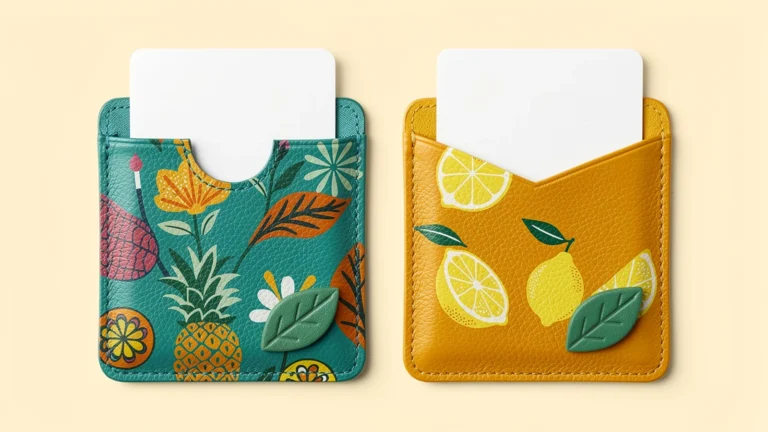
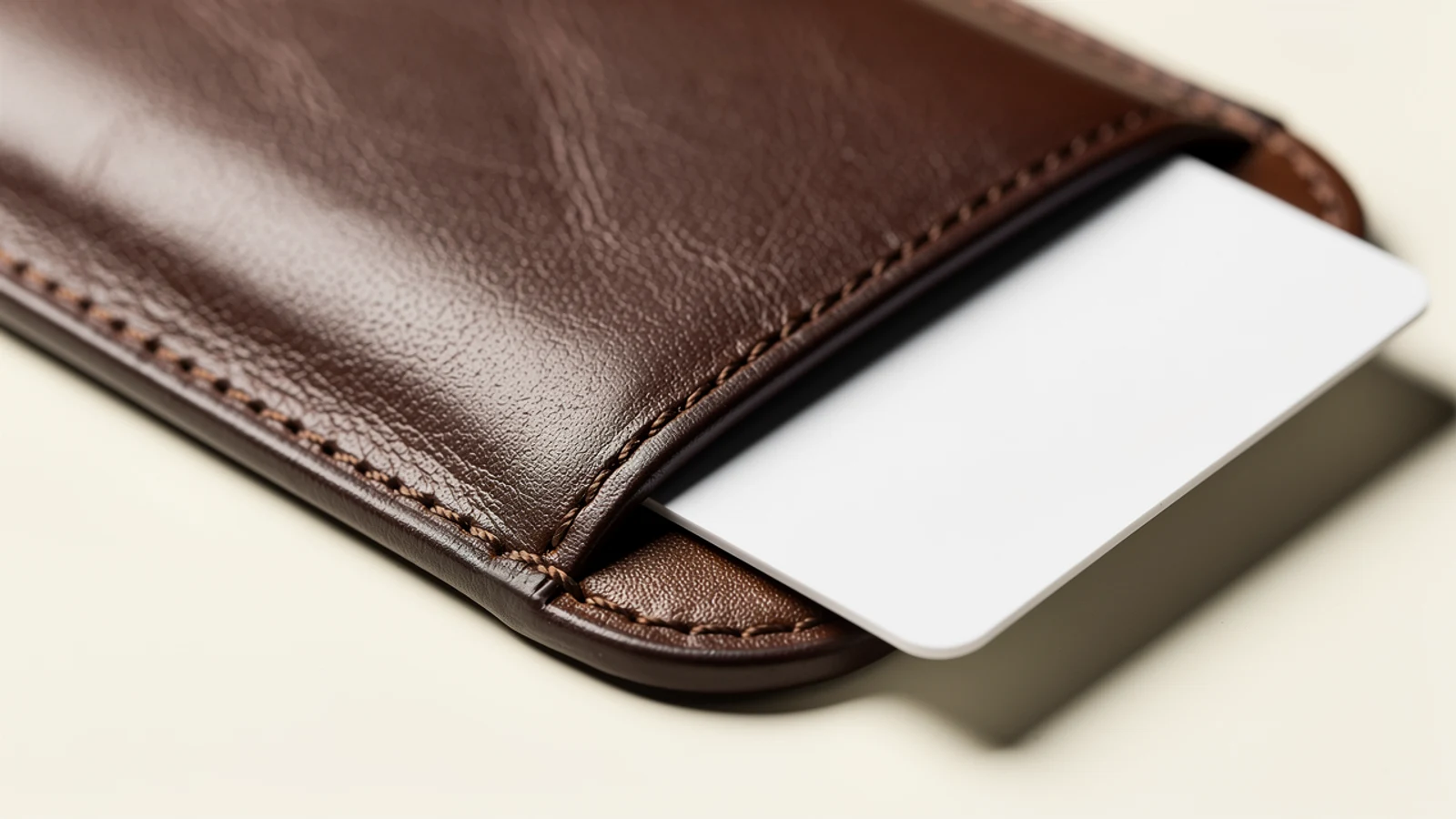
Images are AI-generated concepts, not verified Xinchao product or packaging specifications.
Leather card holder edge finishing should be approved for appearance, handling and the intended construction—not just described as “smooth edges” on an order sheet. Check the whole perimeter, including corners and pocket openings, and connect the approved result to a specific sample and material.
For buyers sourcing custom leather card holders, edge review is a focused part of sample approval. A good-looking front panel does not answer whether an edge feels rough, whether an opening is clear or whether the proposed finish meets an agreed handling requirement. Inspect those questions directly before approving the order.
Clarify the proposed edge construction
Ask the supplier to identify how the edge will be finished. Descriptions may refer to an applied edge coating, a turned or folded edge, or another treatment suited to the material. Request a close-up and a physical sample where practical rather than assuming that similar product photographs show the same construction.
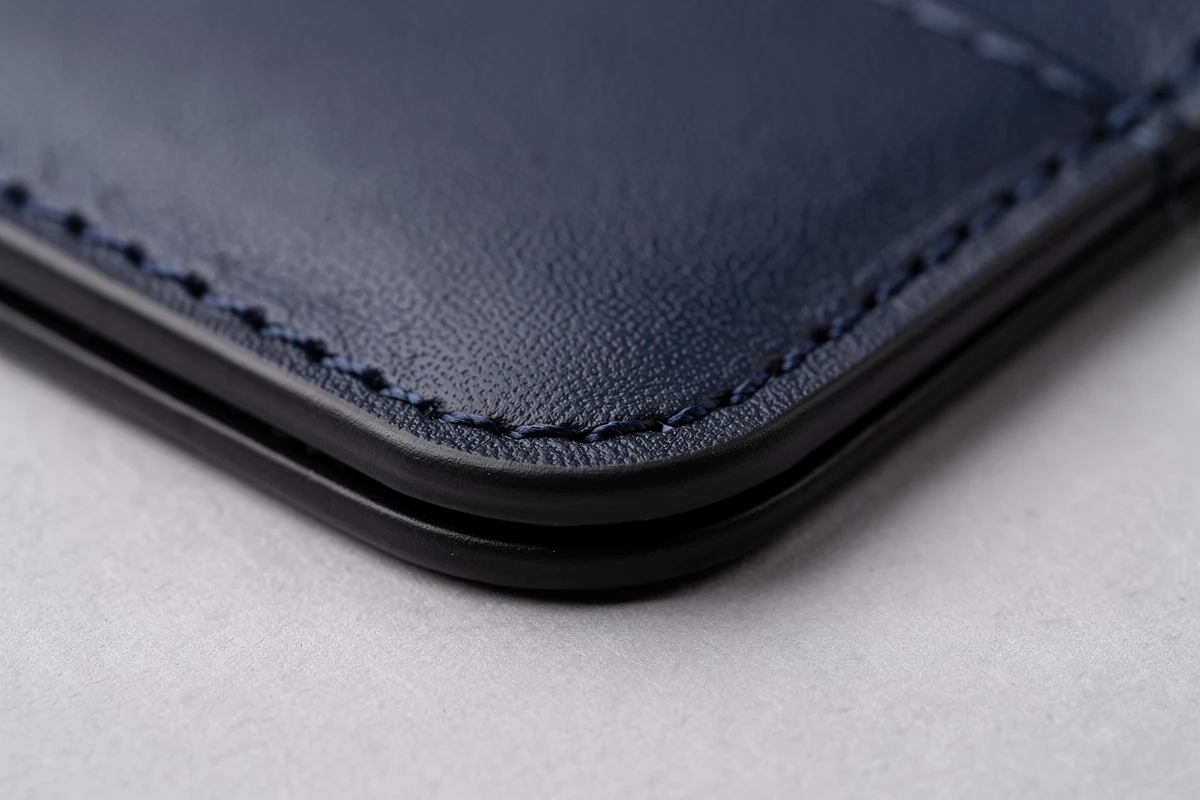
Separate construction from color. “Black edge” describes an appearance, but does not explain the material layers or finishing process. Likewise, a visible stitch line does not by itself identify the treatment of the cut edge beside it.
Edge-finishing supplier Fenice lists separate edge colors, sealing bases and adhesion-related products. That illustrates why an applied finish can involve more than a color choice. It does not establish which products Xinchao uses or what performance a particular card holder achieves.
For a buyer, the useful requirement is the agreed finished result on the proposed material. Unless a specific process is essential to the project, ask the supplier to explain a suitable approach and provide a sample for review rather than prescribing an unsupported recipe.
Inspect the whole perimeter in a consistent sequence
Start at the card opening and work around the holder. Look at the front, reverse and narrow edge, then repeat around any additional pockets or attachment features. This sequence helps prevent a clean front-facing photograph from becoming approval of areas that were never examined.
Use ordinary viewing first, followed by close inspection where a concern appears. Photograph a potential issue both in context and close up. A heavily enlarged image alone can make it difficult to judge the location or practical significance of a small mark.
| Area | What to observe | Question for the supplier |
|---|---|---|
| Straight perimeter | Continuity, coverage and visible layer alignment | Does this match the approved reference? |
| Rounded corners | Uneven buildup, gaps or changes in the edge profile | Is the corner representative of the intended finish? |
| Pocket opening | Clearance and material or finish projecting into the opening | Does anything interfere with the intended card? |
| Front and reverse faces | Unwanted finish marks beside the edge | How will the acceptable boundary be defined? |
| Attachment area, if present | Local separation or rough contact surfaces | Does the complete assembly meet the agreed use? |
These are inspection prompts, not automatic defect classifications. Agree which observations are acceptable and which need correction for the actual order.
Review feel without turning inspection into a damage test
Handle the sample as a user would. Check the perimeter where fingers contact it during insertion and removal. Note rough, sharp or sticky areas if present, and identify their locations precisely.
Do not scrape the edge with a fingernail, pull apart layers or apply cleaning chemicals unless an agreed test specifically calls for that procedure. An improvised destructive check can create damage without providing a useful basis for comparison.
If a surface feels tacky or leaves a mark during ordinary handling, set the sample aside and ask the supplier to investigate. Record the observation and sample condition rather than immediately declaring the cause. A photograph cannot establish the chemistry, preparation or processing history behind the result.
For products with a window, lining or accessory, review the combined item. Approval of the leather perimeter does not automatically approve the exposed edges of every other component.
Check card access after the finish is complete
Use the intended card or an appropriate dummy with the same relevant dimensions and thickness. Insert it through the finished opening and remove it using the intended grip. Check whether there is an obstruction, unwanted rubbing mark or unexpected change in handling.
This is a functional check of the finished sample, not a request to force extra cards into it. Keep the load consistent with the specification. If access differs from an earlier development sample, compare the revisions and ask what changed before attributing the difference to edge finishing alone.
For multi-pocket designs, inspect each opening. A well-finished outer border does not establish that the less visible internal positions have been reviewed. Make sure the sample supplied for approval represents the complete configuration being ordered.
If a revision is needed, describe the affected location and the observed behavior. “The upper pocket opening catches the dummy card at the left corner” gives a clearer starting point than “improve the quality.”
Approve the edge appearance with the body and stitching
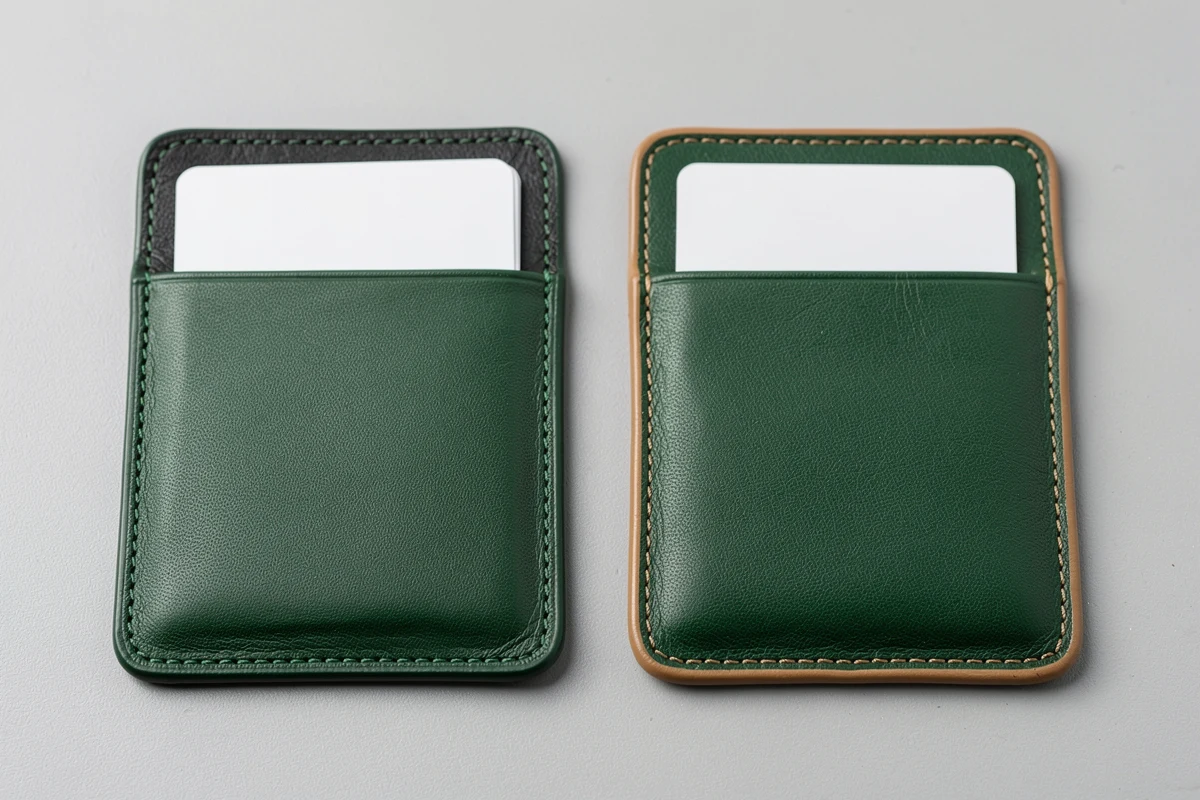
Decide whether the edge should coordinate with the body or provide a deliberate contrast. Review its visible width and sheen alongside the stitching and material surface. Keep the accepted appearance tied to a physical reference rather than a color name alone.
Inspect each relevant colorway. A contrasting edge that works on a dark holder may not produce the intended appearance on a lighter version. If the order includes several combinations, identify which ones the approval actually covers.
Do not infer a particular leather grade or expected lifespan from an attractive edge. Nor should a visibly layered edge automatically be called unacceptable without checking the agreed construction. The comparison should be against the approved specification, not an unrelated product used as a universal benchmark.
If the customer changes the material after approving the finish, ask whether another sample review is needed. Approval on one substrate should not silently transfer to a different material or coating.
Separate visual approval from durability evidence
A clean edge on a new sample establishes its observed appearance at that point. It does not establish how long the finish will last. If resistance to repeated handling is a buying requirement, define the intended use and agree how that requirement will be evaluated.
Ask for the test method, sample configuration, conditions and acceptance criteria behind any offered performance claim. Avoid adding an arbitrary bending count or lifetime promise to the order. Where specialist evaluation is required, have the appropriate parties agree on it before testing or marketing the result.
Keep the records separate: visual approval, functional handling observations and any agreed performance results. A result in one category should not silently mark the others as complete.
Create a short edge-approval record
Before accepting the final sample, record:
- Product and material reference, including the approved revision.
- Proposed edge construction and intended visual effect.
- Locations reviewed, including pocket openings and corners.
- Body, stitching and edge combinations covered by approval.
- Any agreed appearance limits or reference examples.
- Card load used for the functional review.
- Additional performance checks, if required, and their status.
- Outstanding corrections and the sample used to close them.
This is a suggested procurement record, not a statement that a particular factory already follows this procedure. Confirm how the supplier will carry the accepted requirements into the order and how proposed changes will be reviewed.
FAQ
What should buyers check in leather card holder edge finishing?
Check the perimeter, corners and pocket openings for the agreed appearance and handling. Review visible coverage, layer alignment, unwanted marks and any interference with the intended card, using the approved construction as the reference.
Does a smooth edge prove that a card holder is durable?
No. A smooth new edge describes an observed appearance and feel, not a service-life result. Ask for an agreed evaluation and supporting records if durability is a specific buying requirement.
Should I scrape or pull the edge during sample inspection?
Not unless an agreed test requires that procedure. Start with ordinary handling and documented observations. Improvised damage tests may alter the sample without providing a useful basis for acceptance.
Can one sample approve the edge finish on every material?
Not automatically. Identify the material and combinations covered by approval. If the substrate, finish or construction changes, ask whether the affected checks need to be repeated on a revised sample.
What is the clearest way to report an edge problem?
Identify the sample revision and exact location, describe the observed appearance or handling issue, and provide a contextual photograph plus a close-up. Avoid assigning a technical cause before the supplier has investigated it.
To review edge requirements for your project, contact Xinchao with the intended material, appearance reference and card holder layout.