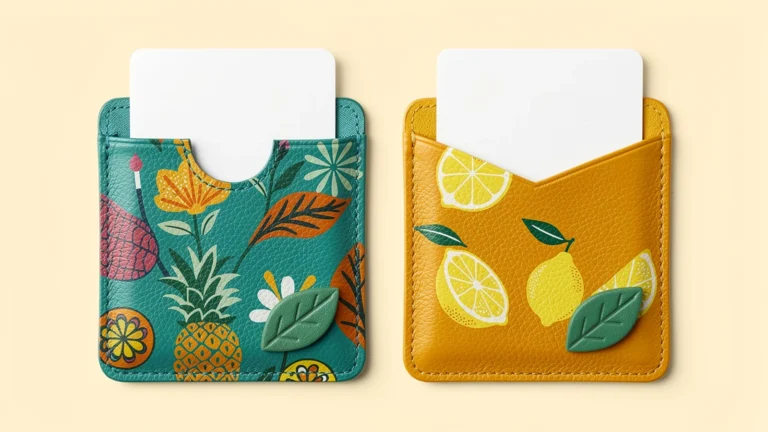
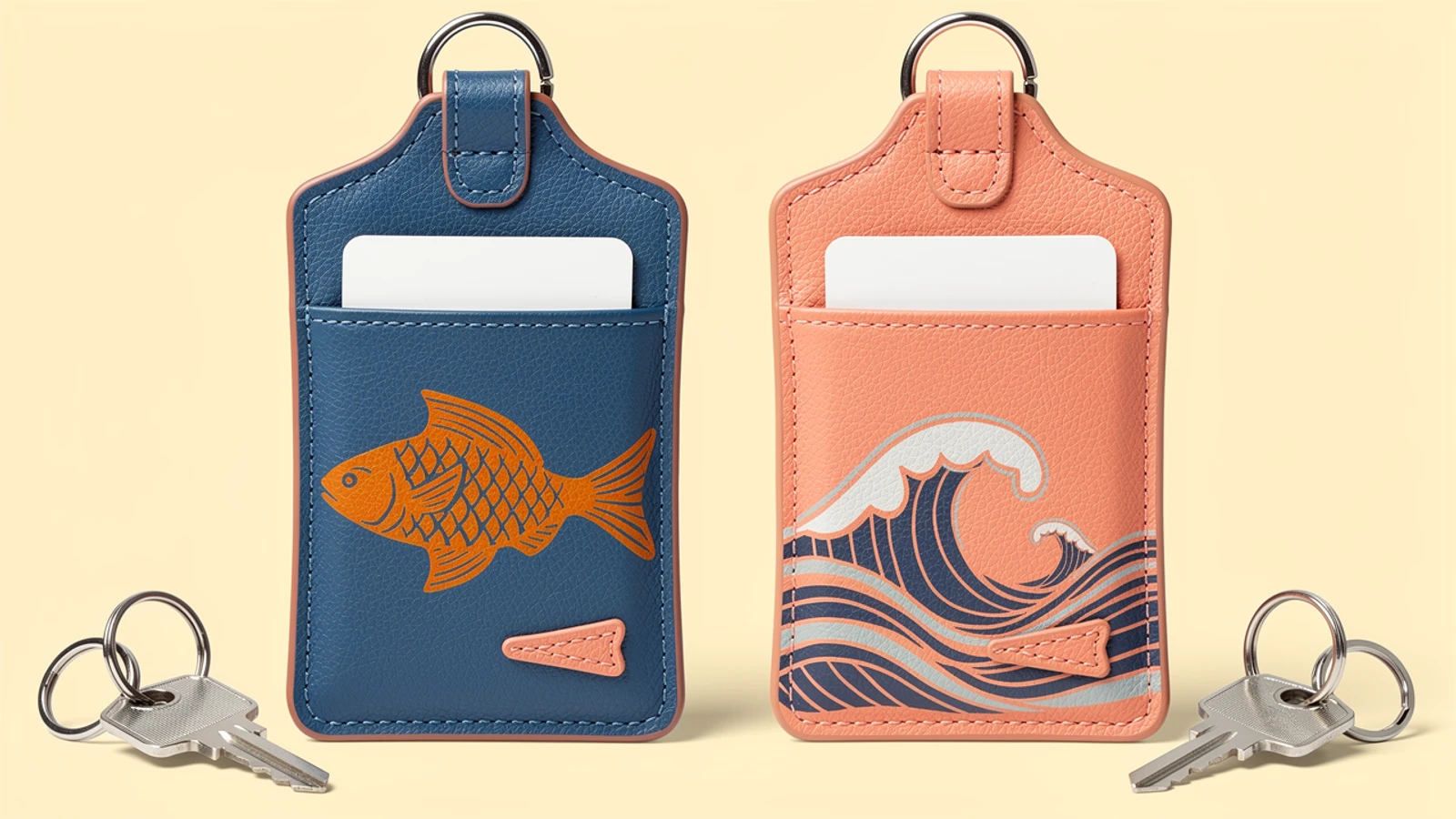
Images are AI-generated design concepts, not production photographs or approved Xinchao specifications. PU denotes synthetic leather, not genuine leather.
A key ring pass case combines card storage with a place to attach a key. The important design decision is not simply where to add a ring: it is where the key rests, swings and moves during use. For a custom printed version, review those movements before approving the artwork, decorative layers or attachment position.
This guide focuses on printed PU leather card holders for Japan-facing merchandise. PU is synthetic leather, not genuine leather. The illustrated concepts show an external ring, not a closed key compartment. A buyer requesting a combined key case and pass case should specify which of those arrangements is intended, because they require different construction and sample checks.
Define the combination before choosing the hardware
Start with the intended card and a representative key. Record the key's overall shape, head and any cover or accessory normally fitted to it. A small flat key and a bulky electronic fob are not interchangeable sample loads. Do not quote a general key capacity from the number of rings shown in a drawing.
Japanese products demonstrate the combined-use category. The official LIHIT LAB. pass and key case page describes carrying an IC card and keys together. This supports the application, not the capacity or construction of a custom PU design. Another product's ring arrangement or performance should not become an unverified Xinchao specification.
Choose among an external key ring, a separately enclosed key compartment or a removable key attachment. An external ring leaves the key exposed. Enclosing it requires space for the key and a suitable opening. A detachable arrangement introduces another connector to specify and check. Make the choice explicit before requesting a quotation.
Map where the key can move
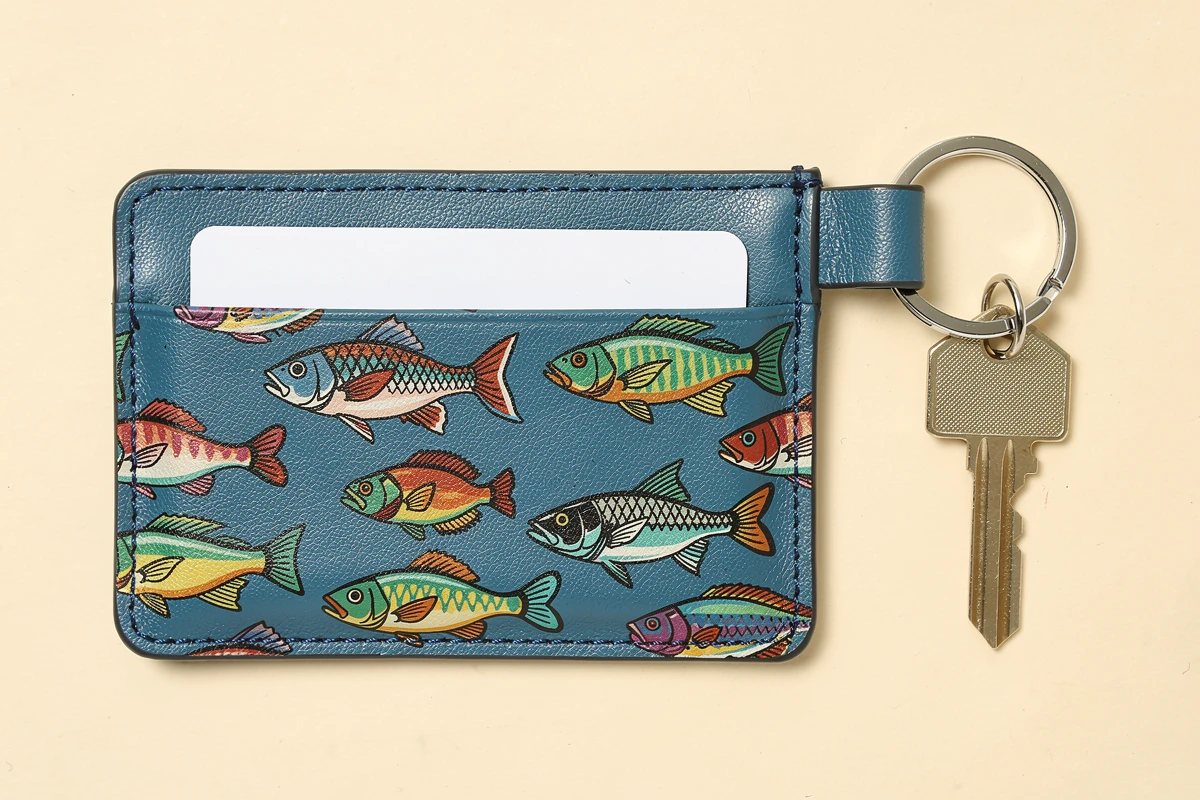
Lay the intended key beside a full-size drawing and then attach it to the sample. Observe the key resting on each face, hanging below the holder and being moved for use. A photograph with the key carefully placed outside the product cannot show every possible contact point.
Look for contact with the exposed card edge, clear window, pocket opening, printed surface and any separate decorative piece. If contact is unwanted, revise the attachment location or construction rather than assuming the user will always arrange the key neatly. A longer connector is not automatically an improvement: it changes the movement to be reviewed.
Check the card opening with the key attached. Fingers should have room to reach the intended card without moving it past a key head or forcing it around hardware. If the holder must be detached to use the key, include that step in the intended routine and confirm that the buyer accepts it.
| Item | Define before sampling | Observe on the assembled sample |
|---|---|---|
| Key | Representative shape and attached cover | Resting position and movement |
| Ring | Exact hardware reference | Fit with both key and attachment |
| Card pocket | Intended card and sleeve | Access with the key attached |
| Attachment tab | Location and construction | Shape and movement under the agreed load |
| Print and overlay | Artwork and separate-part positions | Contact with key and hardware |
Treat the ring and its attachment as one assembly
Specify the ring together with the tab, eyelet or other connection to the holder. A ring that fits the key may not suit a narrow attachment. Likewise, choosing the appearance of an eyelet does not determine how the surrounding material should be reinforced. Ask the supplier to propose and identify the actual construction.
Review installation as well as daily use. Check that the chosen key can be fitted by the intended method, that the hardware sits as expected afterward and that the key can move without forcing the tab into an unintended position. Do not ask a reviewer to improvise with sharp tools or bend a component simply to make the sample fit.
A short handling check is not a load-rating or durability test. If the order requires a particular strength or repeated-use performance, agree the conditions, test method and acceptance criteria separately. Avoid anti-loss, scratch-proof or lifetime claims based on a convincing product image. Record sample observations as observations, not as certification.
Keep card storage independent from key capacity
One or two independent card pockets can be an initial design brief. Three to five can be considered when there is a clear storage task, but extra layers and loaded access need review. These are design options, not verified market-share rankings. A key compartment is not another card slot, and a printed face is not automatically a pocket.
Use the complete proposed contents when comparing layouts. An empty holder with an empty ring may appear compact while the assembled key-and-card load behaves differently. Check how it sits in the intended bag compartment or other carrying location without forcing it into place. The guide to loaded thickness in slim pass cases provides a related review framework.
If in-holder contactless use is expected, evaluate the actual card, reader and complete carrying configuration. Neither an external ring nor a metal key proves reliable reading or RFID-blocking performance. Make card removal an explicit part of the brief where the relevant reading setup has not been confirmed.
Place printed details outside the contact path
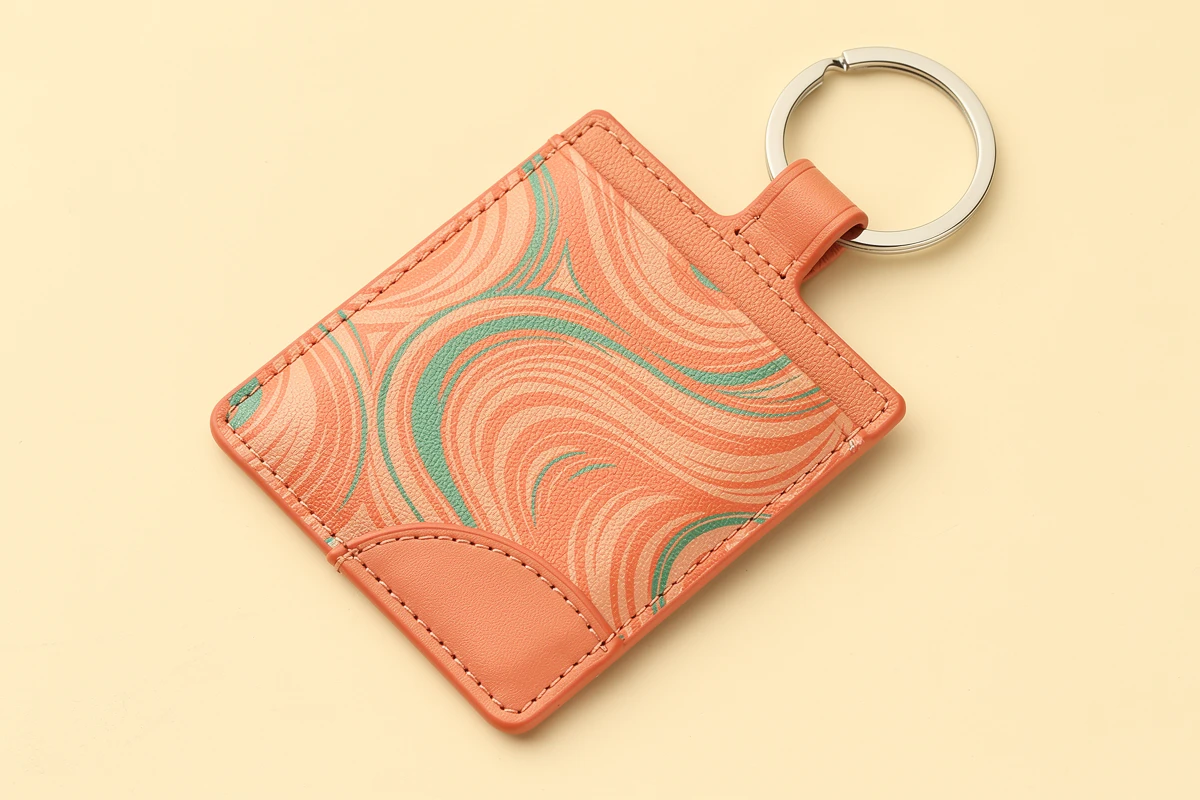
Use the main surface for original full-color illustration. A fish, wave or abstract motif can create a coordinated collection without copying third-party characters. Keep critical wording or a small focal graphic out of areas that the key is expected to cover. Approve how the design looks in the carrying configuration, not only in an isolated flat lay.
An irregular outside contour can be considered while preserving the internal card area and attachment space. A thin fin-shaped or leaf-shaped PU overlay can add a physical layer, but its edge should not become an obstacle to the moving key. Printed shadows and separate pieces must be identified differently in the drawing.
Confirm the fixing method and position of a separate layer through the sample. Do not use a thick molded ornament in the visual proof when the brief calls for a thin PU sheet. If the attachment is relocated after sampling, check the artwork again because the key's contact path and the visible design may change together.
Approve a complete carrying configuration
Keep the artwork version, material reference, pocket drawing, hardware references and representative key description in one approval record. Photograph the same sample with its agreed contents and attachment, including both faces and the card opening. Note any contact that the buyer accepts as part of the chosen arrangement.
Specify whether the key is only a demonstration prop or part of the delivery. For most custom holder briefs, the purchaser supplies its own key; do not allow a product illustration to imply otherwise. State whether the ring arrives fitted, which accessories are included and how they are packed.
For quotation, provide quantities, artwork versions, pocket count, attachment proposal, intended key type and packaging requirements. Ask the supplier to confirm feasibility, minimum quantities and timing for that brief. The Xinchao leather card holder overview is the product starting point; the approved movement and storage plan defines this combination.
FAQ
Is a key ring pass case the same as an enclosed key case?
No. An external ring leaves the key exposed, while an enclosed key compartment contains it within a separate space. Specify the intended arrangement before development.
How many keys can a custom ring hold?
The ring count alone does not establish capacity. Review representative keys, their size and the complete attachment under agreed conditions before stating a supported configuration.
Can the product have two or more card pockets?
Multiple independent pockets can be proposed. Check the full card-and-key load for access and bulk, and describe the card pockets separately from any key compartment.
Does the metal hardware provide RFID protection?
Do not infer RFID-blocking or reliable contactless reading from the presence of metal. Evaluate the intended card and reader with the complete configuration where that function is required.
What should be approved before production?
Approve the artwork, material and pocket references, ring and attachment, representative key configuration, accepted contact points, included accessories and packing instructions.
To discuss a printed key ring pass case, send Xinchao the card-and-key carrying brief with the proposed attachment and artwork.