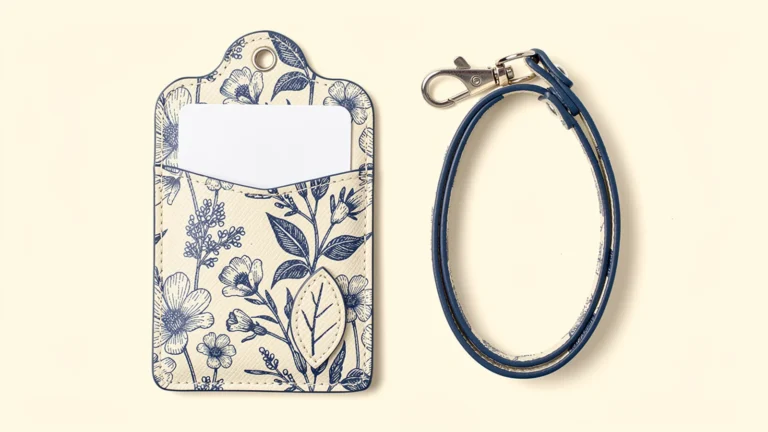
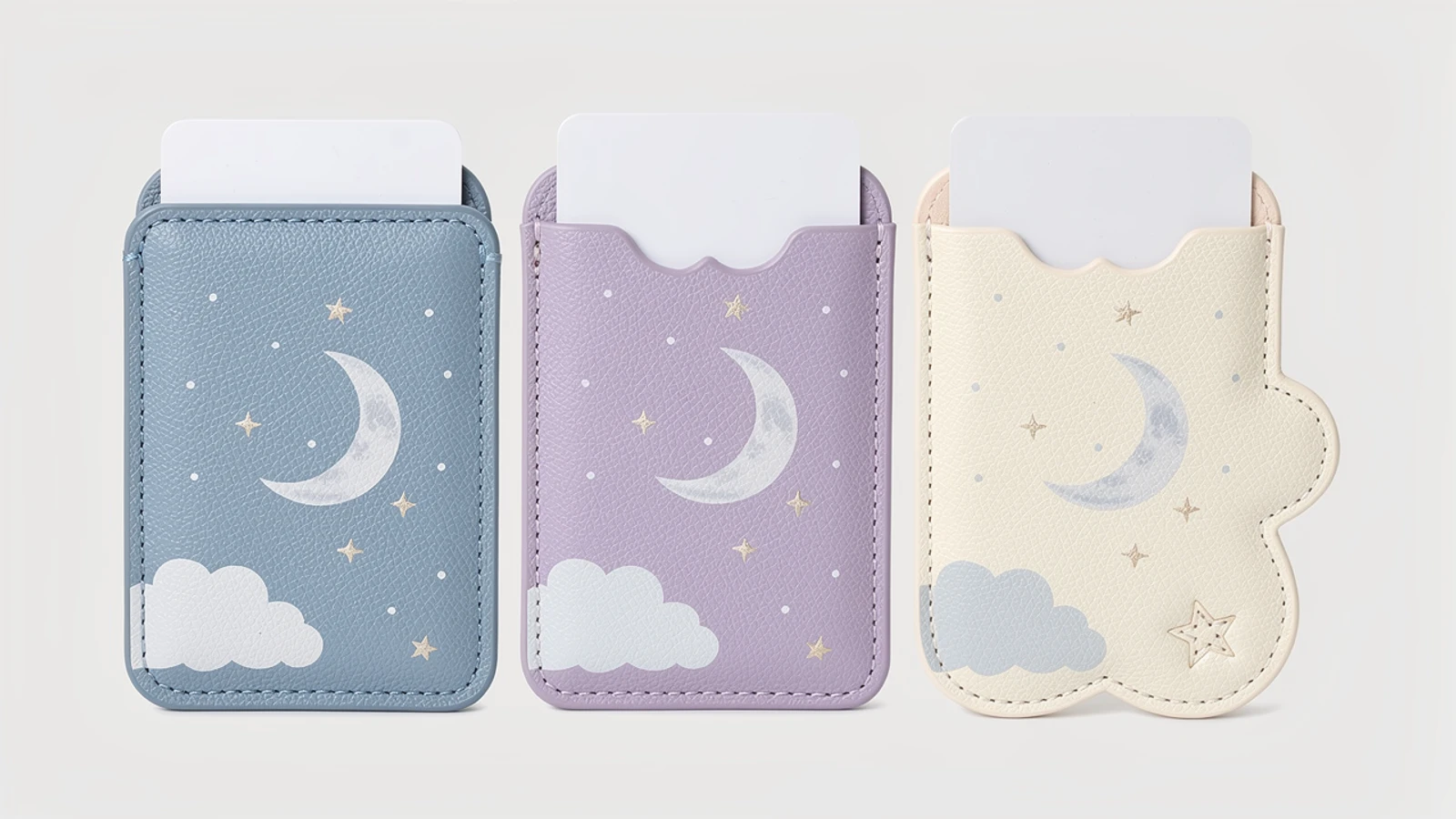
Images are AI-generated design concepts, not production photographs, measured samples or approved Xinchao specifications. PU denotes synthetic leather, not genuine leather.
A slim printed pass case should be approved in its intended loaded condition, not only as an empty sample. Define the cards, pocket arrangement and points where thickness matters before discussing a target profile. The body, seams, attachment hardware and decorative layers do not necessarily have the same thickness.
For a Japanese-market merchandise project, full-color print can provide visual detail while a small separate applique supplies a physical accent. The design task is to decide where added depth is useful and where it makes carrying or access less convenient. “Slim” should describe an agreed product requirement, not substitute for a drawing or measurement method.
Start with the place the holder must fit
Ask whether the holder will sit in a jacket pocket, a bag compartment or hang outside a bag. Record the actual available space and how the user removes it. A thin center section does not establish that a wider silhouette or projecting hardware will pass through a narrow opening.
Separate three requirements: the overall outline, the local thickness and the loaded weight. They are related in everyday use but are not interchangeable. Do not describe a lightweight case as thin without checking its profile, or a small footprint as proof that it fits a particular pocket.
Japanese maker HERZ describes keeping its pass case constructions unobtrusive in a pocket. That supports the relevance of carrying comfort as a design question; it does not provide a universal thickness limit or verify another manufacturer's construction.
Agree on empty and loaded measurement conditions
Give the supplier representative inserts with their actual dimensions and thickness. Include sleeves if they will be used. Specify a minimum and maximum intended loading arrangement, naming which card goes into which pocket. A proposed three-card capacity is incomplete if the card types and positions remain undefined.
Ask for a drawing that identifies the measurement locations and whether the reported dimension includes hardware or decoration. Agree on how the material will be supported and measured so the comparison is not distorted by different compression or positioning. Avoid borrowing a millimeter target from an unrelated product photograph.
| Area to review | Why it matters | What to record |
|---|---|---|
| Main body, empty | Shows the basic assembled construction | Location and agreed measurement method |
| Main body, loaded | Represents the intended carrying condition | Exact inserts, sleeves and pocket positions |
| Seamed edge or folded corner | May differ from the center | Which edge or corner is included |
| Snap, ring or attachment tab | Creates a local projection | Whether it is part of the overall envelope |
| Decorative applique | Adds depth at its location | Placement and local profile |
Keep the approved loading description with the result. A number without its conditions cannot reliably compare two samples. The images in this article deliberately contain no dimension claims; they are visual concepts, not measured specimens.
Choose pockets by access, not by an empty profile
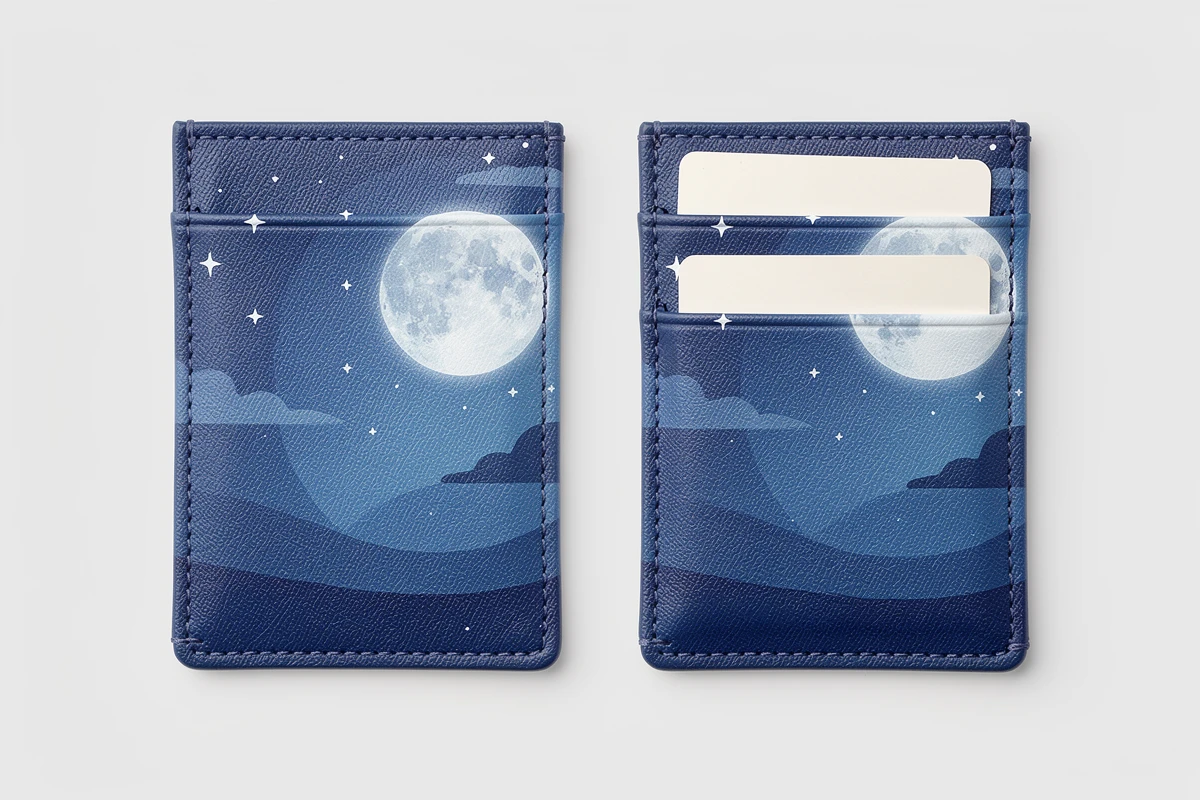
One or two independent pockets are reasonable starting points for a simple carrying task. Three to five can be considered where more separation is needed. Extra pockets create more construction decisions, but pocket count alone cannot predict the final loaded thickness or useful capacity.
Stacked slots, opposite-face pockets and folded arrangements distribute material and cards differently. Compare the actual proposed layouts with the same intended inserts instead of assuming that every two-pocket case has the same profile. The pocket-layout guide separates independent slots, card capacity and display faces.
Check access after choosing the slim profile. The user should not have to bend the card, stretch the opening or pull on a printed decorative piece to remove an insert. Do not eliminate functional clearance solely to make an empty sample look flatter. Likewise, a loose opening is not an acceptable trade-off unless retention has been reviewed for the intended use.
Keep visual detail and physical depth separate
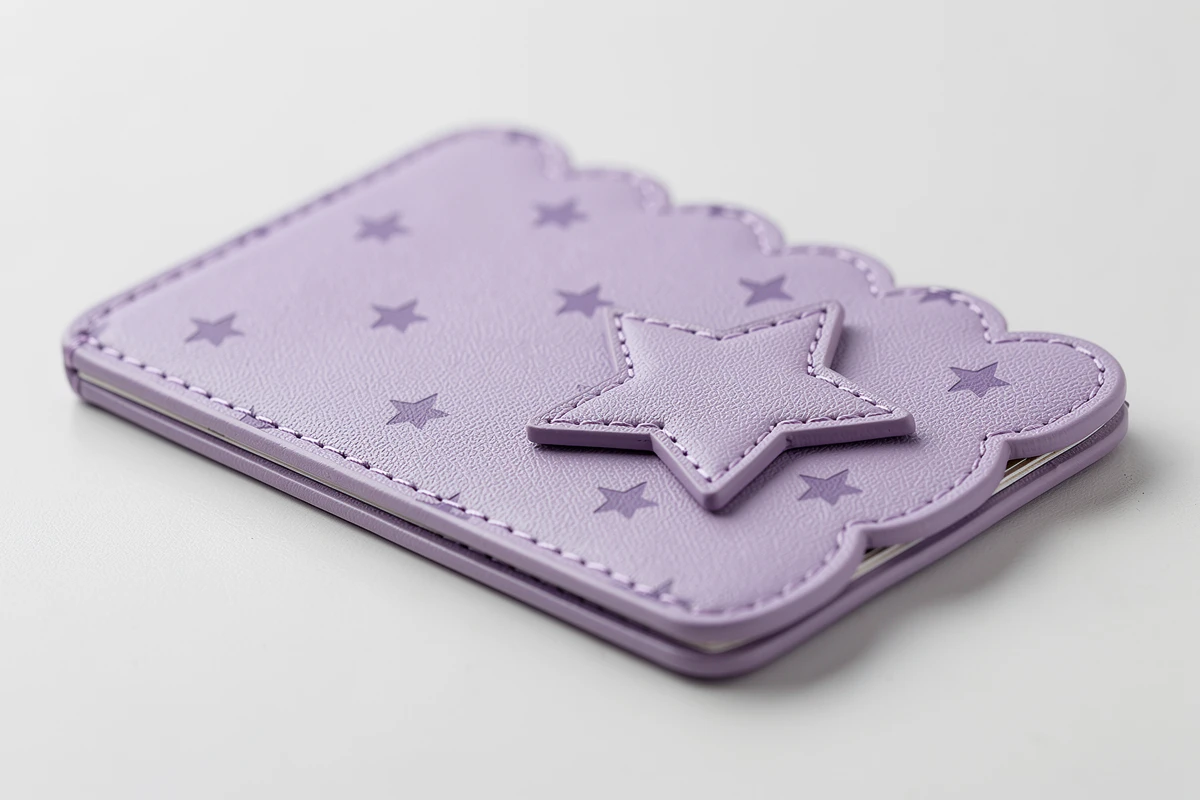
A printed moon, cloud or floral pattern can carry the main illustration without requiring a separate component for every detail. Reserve thin physical layers for selected accents if they contribute to the concept. Specify the applique as a separate part rather than treating its rendered shadow as a thickness specification.
An irregular outline changes the footprint even when it does not add another layer. A cloud-shaped projection may need an additional pocket-entry check, while a small star applique needs a local-depth check. Review both the outer contour and the side view; a front-only illustration hides these differences.
PU is synthetic leather, not genuine leather. Do not assume a particular thin material will meet the project's durability requirements simply because it is described as leather-like. Keep material choice, construction and any performance evidence separate. Our printed and layered pass case guide covers the visual possibilities without defining a universal specification.
Review hardware and the complete carrying envelope
A slim body paired with a projecting fitting may still be awkward in the intended space. Ask for an assembled sample with the selected attachment, not a bare body with a different ring added later. Check how the fitting rests, turns and passes through the intended bag or clothing opening.
Avoid using decorative extensions as assumed attachment points. If an attachment tab is required, specify it and review its construction separately. A small-looking ring or thin tab does not establish strength, and reducing hardware size should not be presented as a validated improvement without review.
Do not infer contactless-card performance from thickness. A thin holder is not automatically compatible with every reader, and multiple cards require their own use check. Agree on card and reader testing separately when that function is part of the project.
Approve the sample with a repeatable checklist
Use non-valuable test inserts and record the material, drawing revision and sample identifier. Compare alternatives under the same agreed conditions. A useful review sequence is:
- Check the empty profile at the named locations.
- Add the minimum intended load and review retention and access.
- Add the maximum intended load and check the complete profile again.
- Try the intended carrying space without forcing the holder through it.
- Inspect seams, corners, hardware and decorative pieces from the side.
- Record any changes before approving the final artwork and construction together.
If wear, bending, attachment strength or another performance requirement matters, define the test method and acceptance criteria with the supplier. Do not invent a universal cycle count or claim that a thinner holder is automatically more comfortable or durable for every user.
Write a brief that makes slimness measurable
Provide the use scenario, available carrying space, actual inserts, sleeves, pocket count, loading combinations, outline, printing, decorative components and attachment. State whether the desired thickness concerns the body alone or the complete assembled envelope. Include quantity per design, packaging and the requested delivery date for project review, not as assumed standard terms.
The Xinchao leather card holder page provides a starting point for material, printing and custom shape discussions. Final thickness, capacity and feasibility need the selected construction and sample; this article does not establish a stock slim-case specification.
FAQ
Is the empty thickness enough to compare slim pass cases?
No. Compare the intended loaded condition as well, using the same cards, sleeves and measurement locations. Record whether hardware and decorative projections are included.
Does a two-pocket case always stay thinner than a five-pocket case?
Not as a universal rule. Material, construction, pocket arrangement and loading all matter. Compare the actual assembled proposals rather than predicting thickness from pocket count alone.
Can a slim pass case have a layered printed decoration?
It can be proposed. Treat the decoration as a local projection, keep it clear of access areas and verify the complete holder in the intended carrying space.
Does a thin holder guarantee contactless-card compatibility?
No. Thickness alone does not establish compatibility. Confirm the intended card, reader and complete loaded holder separately if contactless use is required.
What should be included in a slim-case inquiry?
Include the carrying space, actual inserts and sleeves, pocket layout, loading combinations, measurement scope, material, print, decorative layers and hardware, together with quantities and packaging requirements.
To discuss a slim printed pass case, send Xinchao the loading arrangement and carrying-space requirements so the profile and artwork can be reviewed together.