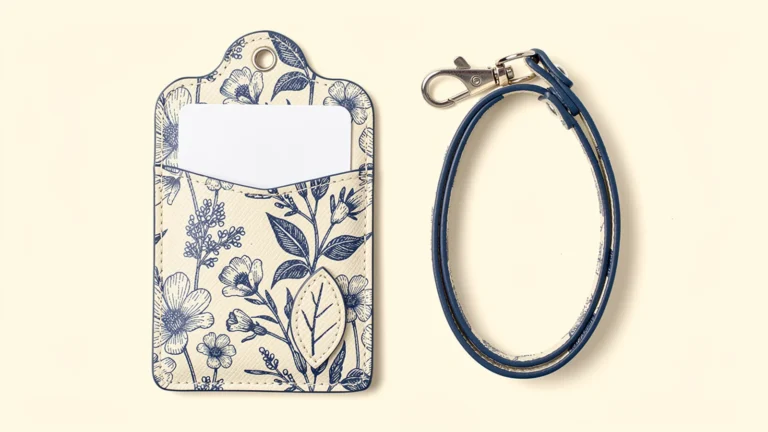
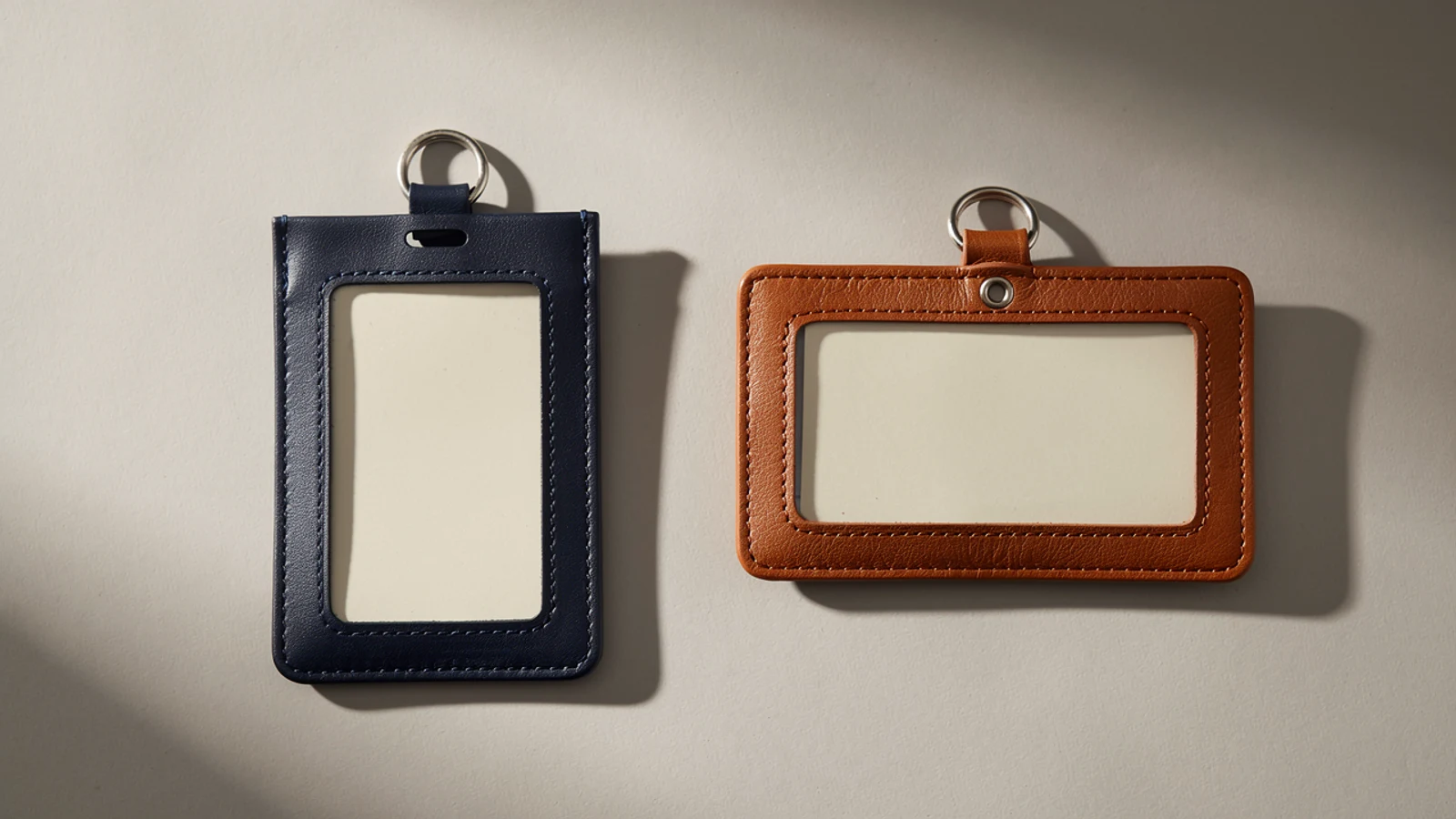
Illustrations in this guide are AI-generated design concepts, not verified Xinchao product specifications.
A vertical vs horizontal badge holder decision starts with the ID card, not the catalog photograph. Choose a vertical holder for a portrait card layout and a horizontal holder for a landscape layout, then confirm that the window, pocket and attachment work together. Matching the direction is only the first check: a holder can accept a card while still covering its name, photograph or access code.
For a custom leather card holder project, the practical goal is an ID that sits upright, presents the required information and remains easy to use with the selected lanyard or clip. This guide explains what buyers should compare before approving a design.
Vertical vs horizontal badge holder: a quick comparison
| Decision point | Vertical holder | Horizontal holder |
|---|---|---|
| Starting card layout | Portrait artwork, read with the short edge at the top | Landscape artwork, read with the long edge at the top |
| Window to review | Tall viewing area around the actual printed content | Wide viewing area around the actual printed content |
| Attachment drawing | Show the connector above the intended portrait face | Show the connector above the intended landscape face |
| Branding space | Check the available margins above, below and beside the window | Check the available margins above, below and beside the window |
| Main risk to avoid | Choosing a portrait shape that hides part of the card | Choosing a landscape shape that hides part of the card |
Neither direction is automatically more professional, more durable or suitable for every workplace. Those outcomes depend on the finished construction and intended use. If the ID artwork is already fixed, use that artwork as the starting constraint. If the card is still being designed, review the holder and card layout together.
Start with the information people need to see
Place the actual ID artwork upright on a screen or printed sheet. Identify the fields that must remain visible: employee name, photograph, organization, expiry date or visitor status, for example. Mark their boundaries before choosing the holder window.
A portrait card may place a photograph above the name, while a landscape card may put them side by side. These are layout possibilities, not rules. Do not assume that every staff card belongs in a vertical holder or every event badge belongs in a horizontal one.
For example, an existing landscape ID with a name running along the bottom needs a viewing opening that clears that line. Rotating the card into a portrait holder may make the text sideways; choosing a wide holder with a thick lower border may still hide it. Both direction and visible area have to be right.
When several departments use different card designs, compare all of them. A window approved against one sample card may not suit a second layout with an expiry date nearer the edge. An anonymized artwork file is sufficient for this review; there is no need to share employees’ personal details.
Separate card size, pocket size and window size
These three measurements answer different questions:
- Card size: what must physically fit inside, including its thickness and any sleeve or laminate used with it.
- Usable pocket size: the space available after seams, lining and closures are accounted for.
- Visible window size: the area through which the printed card can actually be seen.
The holder’s outside dimensions do not establish any of these on their own. A wide outer shape can still have a narrow window, and an attractive drawing may not show how much space a seam consumes.
Ask for a dimensioned drawing that identifies all three. Specify the number of cards as well as their dimensions. If you intend to carry two cards, have the sample assessed in that loaded condition instead of assuming that a single-card fit leaves sufficient room.
For a leather or leather-look construction, also review whether the card can be inserted without excessive bending and whether the opening allows convenient removal. Avoid prescribing a universal extra allowance: the appropriate clearance depends on the materials, pocket structure and required retention. Confirm it with the assembled sample.
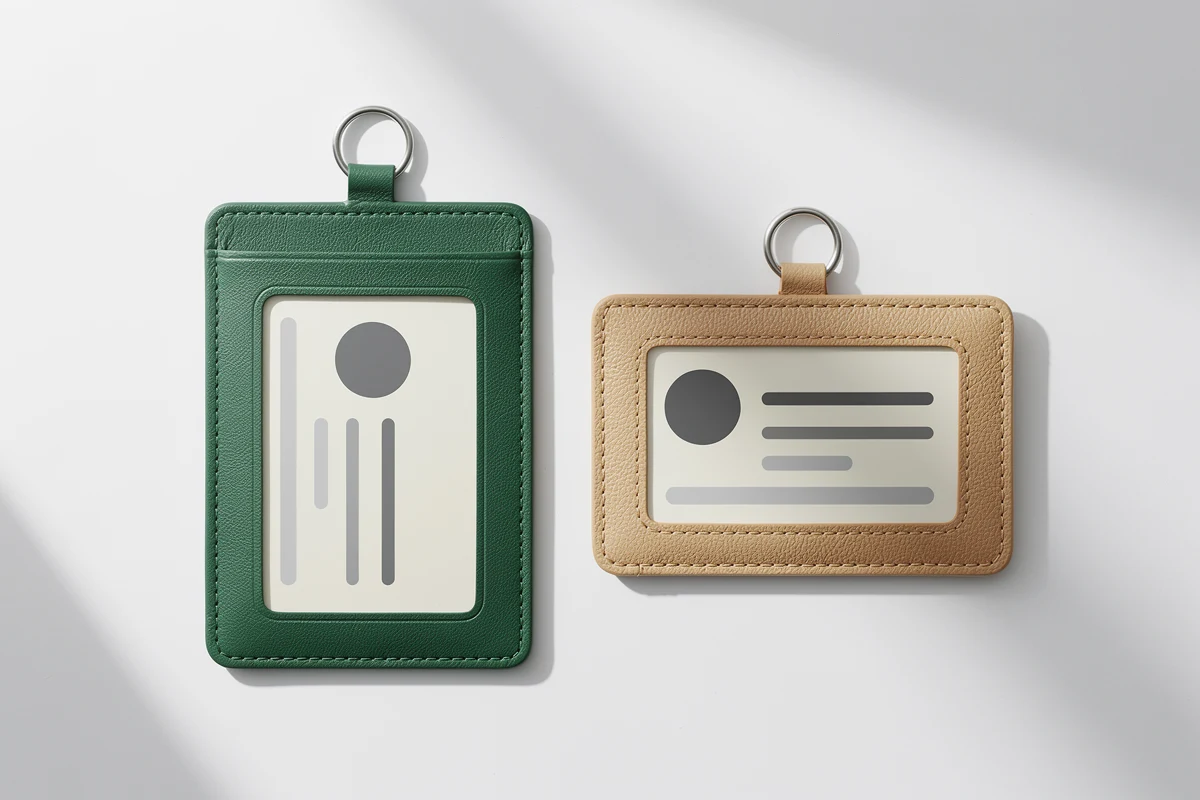
Check the viewing window with the card inserted
Overlay the proposed window outline on the final card artwork, then repeat the check with a physical sample. Look at the corners, the lower name line and any fields near the perimeter. Rounded window corners can obscure content that appears clear in a simple rectangular sketch.
If the card has a barcode or QR code that must be scanned through the holder, test the actual code, window film and intended reader together. Include the clear space surrounding the code in the visibility review. A visually exposed code is not proof that the complete arrangement will scan reliably under working conditions.
Ask whether users need to show the reverse of the card. A front-window design may require removal or turning the holder around, while another construction may provide a second viewing opening. That is a separate requirement from portrait or landscape orientation and should be written into the specification.
Match the attachment to the wearing direction
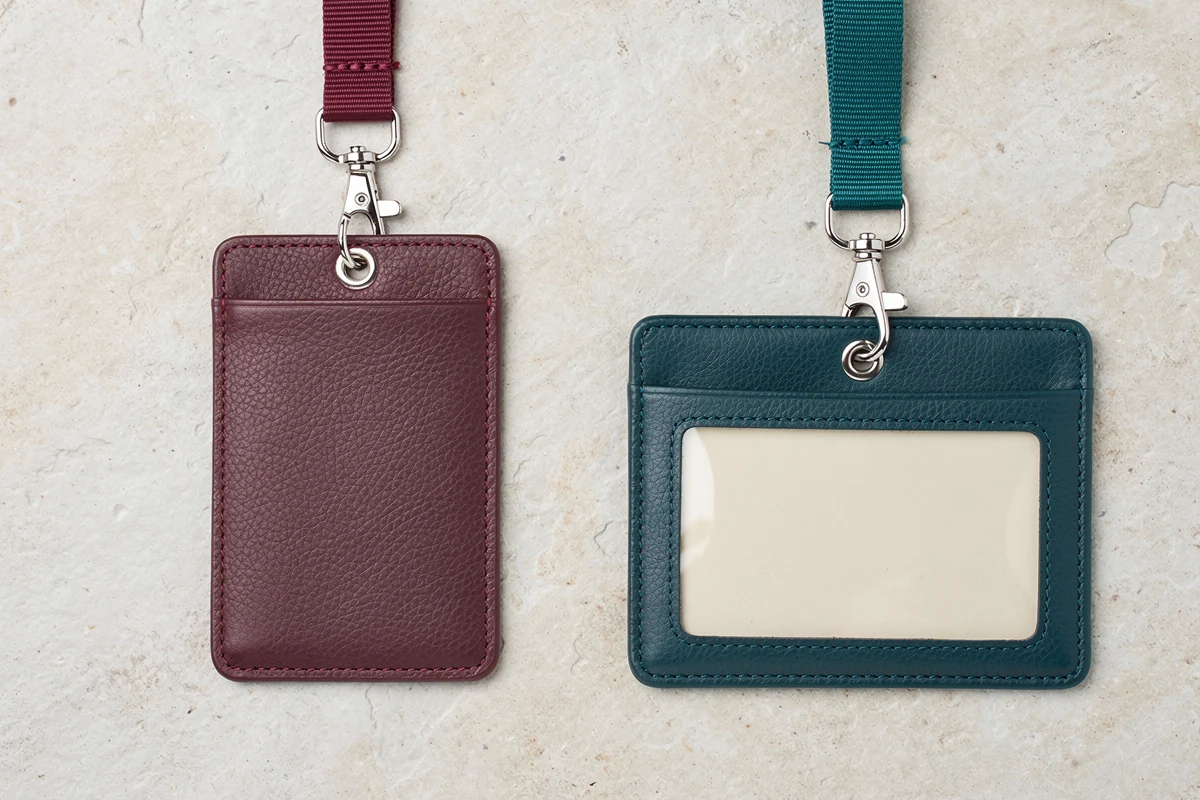
The attachment helps determine how the holder hangs. In the drawing, show the ID upright and locate the ring, slot or tab relative to that face. Do not approve the outer shape while leaving the connector to be decided later.
A single central connector, two attachment points and a swivel clasp create different assemblies. Orientation alone does not establish which assembly will stay facing forward. If reduced turning matters, ask the supplier to propose an arrangement and check it while worn; do not treat the word “vertical” as a promise of stability.
Review the complete set with the intended lanyard, reel or clip. Check whether hardware obstructs card insertion, presses against the holder edge or covers information when the holder moves. Where access cards must reach a reader, test that movement with the actual accessory rather than only measuring the holder on a desk.
Workplaces with specific lanyard safety requirements should define those separately. A portrait or landscape shape does not establish breakaway performance or suitability for use around equipment.
Keep branding separate from the ID viewing area
A logo on the holder and a logo printed on the ID card occupy different surfaces. Decide which one carries the main branding before assigning space around the window. Enlarging a decorative border to accommodate a logo can reduce the visible area needed by the card.
For custom printing, embossing or another proposed finish, request a placement drawing on the selected holder shape. Check the distance from seams, folds and hardware. Do not simply reuse the same logo coordinates when changing from portrait to landscape: the available surface has changed.
Color and material decisions can then support the chosen design. Our leather card holder overview is a starting point for discussing a custom configuration. The orientation drawing should still identify the exact material construction and finish requested for the order; “leather card holder” alone is not a complete purchasing specification.
Use these three buying scenarios to narrow the choice
Existing employee IDs with fixed artwork
Keep the existing reading direction. Send the supplier the card dimensions and an anonymized layout, with required visible fields marked. Compare the proposed window against that layout before considering logo treatments or additional pockets.
A new visitor or event badge system
Choose the information hierarchy first. Establish which fields need to be read at a glance, then develop the card artwork and holder window together. Review a printed mock-up at actual size; an enlarged screen preview can make cramped information appear more readable than it is.
One branded range with portrait and landscape versions
Treat them as two related specifications, not one design rotated ninety degrees. Keep shared colors and branding where useful, but confirm each version’s pocket, window, opening and connector. Label the variants clearly in the quotation and packing requirements to reduce the chance of mixing them during ordering or distribution.
What to send with a quotation request
A useful brief gives the supplier enough information to evaluate the whole assembly:
- Portrait or landscape card artwork, with sensitive information removed.
- Actual card width, height, thickness and required quantity per holder.
- Fields that must remain visible, including any scanning area.
- Whether access to the reverse side or frequent card removal is required.
- Preferred material, color and logo treatment, with references where available.
- Intended lanyard, reel or clip and the proposed connection arrangement.
- Order quantities by orientation and color, packaging needs and target delivery date.
Ask the supplier to flag unresolved dimensions or component choices in the quotation. When the sample arrives, insert the intended card, attach the selected accessory and check the complete use sequence. Approve the configuration that works, not just the outline that looks right.
FAQ
Is a vertical or horizontal badge holder better?
Neither is universally better. Start with the card’s upright reading direction, then compare the usable pocket, visible window and attachment. The better option is the one that presents the required information and works with the intended accessory.
Can a horizontal ID card go in a vertical holder?
It may fit in some constructions, but fit alone is not enough. The artwork may appear sideways or be partly hidden. Check the actual card dimensions and window rather than relying on the holder’s orientation label.
Can the same leather holder design be rotated for both layouts?
Do not assume so. Rotating the outline can change the opening, connector position and available branding space. Confirm a separate dimensioned drawing and assembled sample for each orientation.
Does a clear window guarantee that a QR code will scan?
No. Test the actual code through the finished window with the intended reader and normal handling conditions. Include the surrounding clear space in the visibility check, and keep card removal available if the use case requires it.
What information should I provide for a custom badge holder quotation?
Provide the card dimensions and layout, required visible fields, card quantity per holder, preferred material and branding, intended accessory, and order quantities by variant. Add packaging needs and the target delivery date so the proposed configuration can be reviewed as a complete set.
To discuss a portrait or landscape leather card holder, send Xinchao your card layout and project brief. Ask for a proposed window and attachment drawing before approving the sample.