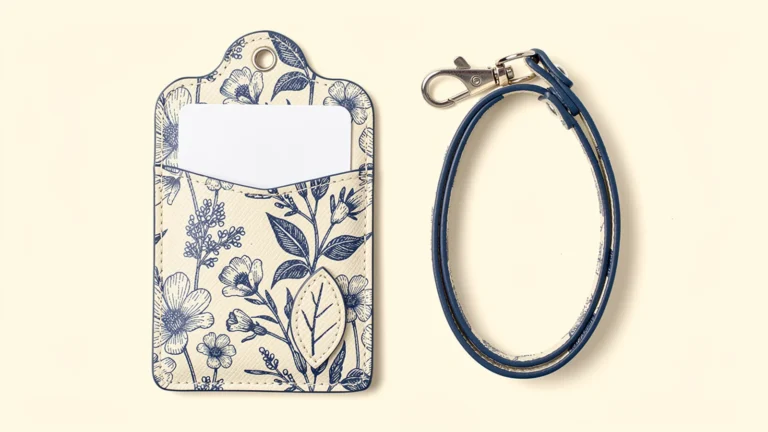

Images are AI-generated concepts, not verified Xinchao product or packaging specifications.
The lanyard vs badge reel decision depends on how the wearer displays and presents an ID. Start with a lanyard when a neck-worn badge suits the clothing and display requirement. Evaluate a badge reel when the card needs to move from a clothing attachment point to a reader. In either case, approve the accessory with the loaded leather holder, not as an isolated component.
A good-looking connector does not establish a comfortable or practical set. Card count, holder weight, attachment geometry and reader position all belong in the selection brief. This guide focuses on the wearing accessory; the holder’s portrait or landscape layout remains a separate decision.
Lanyard vs badge reel at a glance
| Selection question | Lanyard | Badge reel |
|---|---|---|
| Where will the set be supported? | Around the neck, with the holder below | At a suitable clothing attachment point, depending on the reel design |
| How does the card reach a reader? | Through available movement or an agreed detachable arrangement | By extending the reel’s cord within its specified operating range |
| What must be checked first? | Wearing position, connector and permitted workplace use | Attachment security, usable reach and retraction with the loaded holder |
| What should not be assumed? | That every wearer will find the same length comfortable | That every reel can retract every leather holder and card combination |
| What belongs in the sample? | Actual lanyard, holder and connector | Actual reel, attachment strap, holder and cards |
Some products combine a lanyard and a reel. That may suit a particular workflow, but it adds another connection and should be evaluated as its own configuration. Do not assume that combining accessories automatically solves reach, comfort or orientation problems.
Map the wearer’s normal ID routine
Describe the sequence before selecting hardware. Does the wearer only display a name to visitors, present a card at doors, show the reverse side, or repeatedly remove the card? Each task creates a different requirement.
For a reception team, visible identification may be the first priority. For a team that regularly presents credentials to readers, convenient reach may matter more. These are examples of decision criteria, not claims that every receptionist should use a lanyard or every access-card user should use a reel.
Include clothing in the brief. A reel needs an appropriate attachment point for its particular clip or fastening design. Check it with the garments people actually wear rather than only a thick demonstration pocket. For a neck-worn set, review where the holder rests during normal seated and standing activity.
Where the workplace limits neckwear or has specific accessory requirements, obtain those requirements before sourcing. A product name such as “safety lanyard” is not, by itself, proof that it meets the site’s needs. This guide does not establish a safety specification for a workplace.
Evaluate a reel with the complete loaded holder
Reel specifications are model-specific. Manufacturer KEY-BAK’s badge reel range illustrates that reels come in different constructions rather than one interchangeable format. Obtain the current specifications for the proposed model instead of carrying a rating from another reel into your order.
Weigh or otherwise document the complete set the reel must support: holder, intended cards and any permanently attached components. Ask the supplier whether its proposed reel is suitable for that load and how the requirement will be checked. Do not use a cord’s breaking strength as a substitute for the reel’s retraction capability.
At sampling, extend and guide the holder back in its normal wearing position. Check whether it returns as intended, whether the cord or strap catches, and whether the holder presses awkwardly against the reel body. A check with an empty lightweight sleeve does not answer the same question as a check with the final loaded leather holder.
If the project needs formal durability testing, define the load, movement, conditions and acceptance criteria separately. An informal handling check cannot support a claim about years of service or a universal cycle life.

Check reach without treating maximum extension as the target
Show where the reader sits relative to the intended attachment point. Test the normal action with representative clothing and the actual holder. The wearer should be able to present the credential in the required orientation without relying on an awkward body movement.
For a reel, confirm the usable extension specified for the model and assess the task within that range. For a lanyard, check whether the available movement is sufficient or whether a detachable connector is part of the approved workflow. Do not solve a reach issue by specifying extra length without checking where the badge then rests.
The accessory also does not prove that a credential can be read through the holder. If the use case requires reading through the assembled product, test the actual card, holder and reader together. If card removal is required, make sure the attachment does not obstruct the opening.
Match the connector to the holder’s attachment point
A hook, split ring and snap strap interact differently with a slot or reinforced hole. Ask for the actual connector dimensions and compare them with the proposed holder drawing. Confirm that the connector can be fitted and closed without forcing or modifying either component.
Review how it sits after assembly. Check for crowding near stitching, contact with the card opening and an unwanted sideways pull. A connector that can be pushed through the opening is not necessarily the right fit for everyday handling.
Keep front-facing presentation in the review. A swivel component permits movement, but it does not guarantee that a badge will remain facing forward. If orientation control matters, ask the supplier to propose an arrangement and assess it while worn. For the separate card-layout decision, see our vertical vs horizontal badge holder guide.
Avoid adding keys or other items to the set after approval without reassessing it. The added objects change the load and the way the assembly moves. A proposal evaluated for an ID holder should not silently become a general-purpose carrying system.

Compare comfort and handling in a small user trial
Ask representative users to try the proposed set during the intended activities. Record specific observations: badge position, ease of reaching the reader, convenient card removal and whether the clip stays in the chosen location. Separate preferences from failures against a defined requirement.
For example, “the reel clip moves on this shirt pocket when the card is extended” gives the supplier a condition to investigate. “The reel is bad” does not identify whether the problem is the clip, garment, load or action.
If more than one accessory configuration is needed, keep the variants explicit. A mixed order can use the same holder with different approved accessories, provided the compatibility and packing details are confirmed for each set. The selected configuration should follow the task, not simply a department label.
Put the accessory choice into the purchase specification
Before requesting a final quotation, document:
- Holder drawing, card quantity and the complete intended load.
- Lanyard or reel model and attachment method.
- Slot or hole geometry and the selected connector.
- Wearing location, required reach and card-presentation action.
- Required workplace restrictions supplied by the buyer.
- Branding, color and quantities for each accessory variant.
- Assembly, packing and replacement-component requirements.
Specify whether the supplier delivers assembled sets or separate components. If replacements will be sourced later, retain the approved model and connector references; appearance alone may not identify an equivalent part.
The leather card holder overview provides a starting point for the holder configuration. Confirm accessory availability and suitability in the project quotation rather than assuming that every illustrated combination is a standard stocked set.
FAQ
Is a lanyard or badge reel better for a leather ID holder?
Neither is universally better. Choose around the wearing location, display requirement and card-presentation task, then check the complete holder and accessory set with the intended cards.
Can any badge reel carry a leather holder?
No universal compatibility should be assumed. Confirm the proposed reel’s suitability for the loaded holder and check retraction, reach and attachment using the actual sample.
Can I use a badge reel on a lanyard?
Some configurations combine both. Review the complete assembly as a separate option, including its connections, wearing position and card movement, rather than assuming the combination will suit every task.
Does a swivel hook keep the ID facing forward?
Not necessarily. It permits movement but does not guarantee orientation. If the badge must stay front-facing, define that requirement and assess the proposed assembly while worn.
What should I send when sourcing a holder and accessory set?
Provide the holder drawing, card quantity, intended load, wearing location, reach requirement and preferred connector. Include workplace requirements, branding, quantities by variant and whether sets should arrive assembled.
To discuss a complete wearing arrangement, send Xinchao your leather holder requirements and intended ID routine.