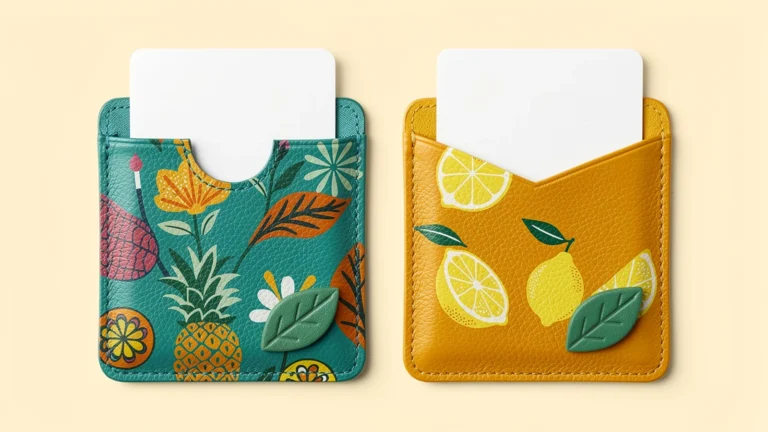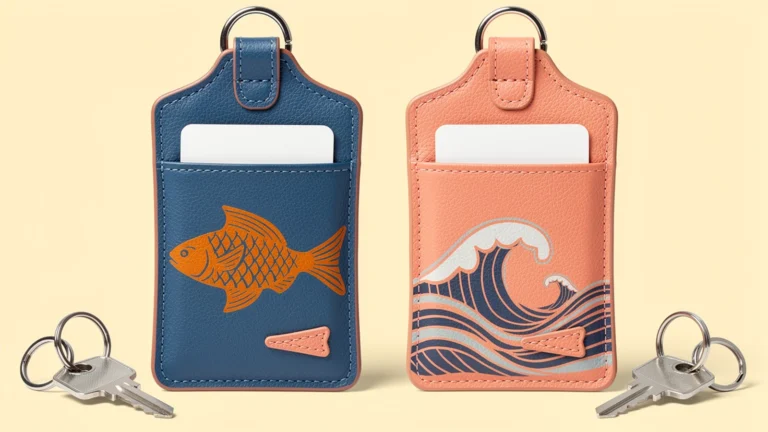
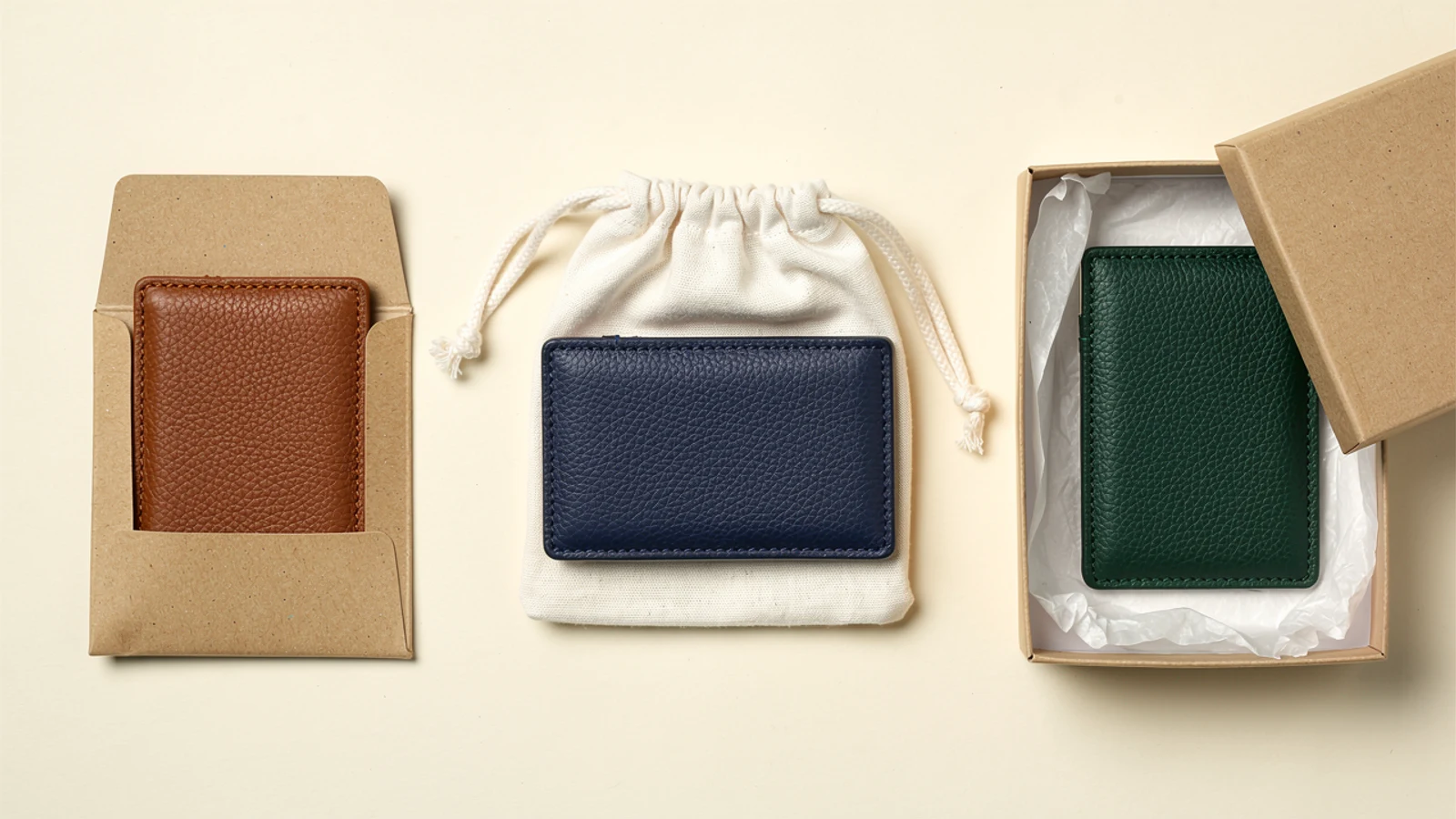
Images are AI-generated concepts, not verified Xinchao product or packaging specifications.
Leather card holder packaging should match how the product will be stored, transported and handed to its user. An individually protected bulk order, a retail-ready sleeve and a presentation gift box solve different problems. Start with the delivery channel, then specify the unit pack, accessory arrangement, variant labels and outer carton together.
For custom orders, choosing a box style is only part of the decision. The pack also needs to hold the correct item, separate hardware from finished surfaces and support accurate distribution. This guide explains what to put in a packaging brief without assuming that every project needs elaborate gift packaging.
Choose leather card holder packaging by delivery channel
Think about who opens the shipping carton and what happens next. A company distributing holders internally may unpack them at a central desk. A retailer may need a unit that is ready for display. A gift program may require the recipient to open a complete presentation set.
| Use case | Packaging option to evaluate | Main approval question |
|---|---|---|
| Internal staff distribution | Individually protected holders grouped by variant | Can staff find and issue the correct item efficiently? |
| Retail sale | Sleeve or box with the required unit identification | Is the pack ready for the intended display and handling? |
| Corporate gift | Presentation box with suitable internal support | Does the complete set arrive arranged as intended? |
| Holder and lanyard set | Unit pack with separated accessory placement | Can hardware move against the holder during handling? |
| Multiple branch deliveries | Clearly identified inner packs and cartons | Can the receiving team route quantities without opening every unit? |
These are options for evaluation, not statements that a particular format is included in every Xinchao order. Confirm availability, dimensions, materials and pricing in the project quotation.
Separate presentation packaging from shipping protection
An attractive unit box is not automatically a complete shipping package. Review how it will be grouped in an outer carton, whether it can move inside that carton and how its corners and surfaces are protected.
UPS’s shipping guidance recommends wrapping items separately and using cushioning. For card holder orders, use that as a general packing principle, then ask the supplier or logistics provider to assess the actual packed configuration. It is not evidence that a particular gift box has passed a transport test.
If distribution involves repeated unpacking and reshipping, describe that route in the brief. A unit pack intended only for centralized handout may not be the right proposal for individual parcel delivery. Where testing is required, agree the route, test method and acceptance criteria with the responsible provider; do not invent a universal carton specification.
Compare sleeves, pouches and boxes on practical details
A paper sleeve can provide a surface for unit identification and a compact presentation, but the amount of product it covers depends on its design. Check exposed corners, fit and whether the holder slides out during normal handling. Do not assume that a sleeve provides moisture protection.
A pouch may offer a reusable presentation option if it suits the project. Check the fabric, closure and fit with the actual holder. A pouch that looks generous when empty may become awkward once a lanyard or other accessory is included. Reusability alone does not prove an environmental benefit; avoid making that claim without suitable evidence.
A folding carton or rigid gift box can organize a complete set. Review the internal dimensions, insert and opening sequence, not just the exterior artwork. Check that the product can be removed conveniently and that the lid closes without pressing on a raised component or bending the holder.
Ask for a plain structural sample before finalizing decorated packaging when the size or arrangement is uncertain. This lets you resolve fit separately from print color and graphics. The final decorated pack still needs its own review.
Keep clips and lanyards away from finished surfaces
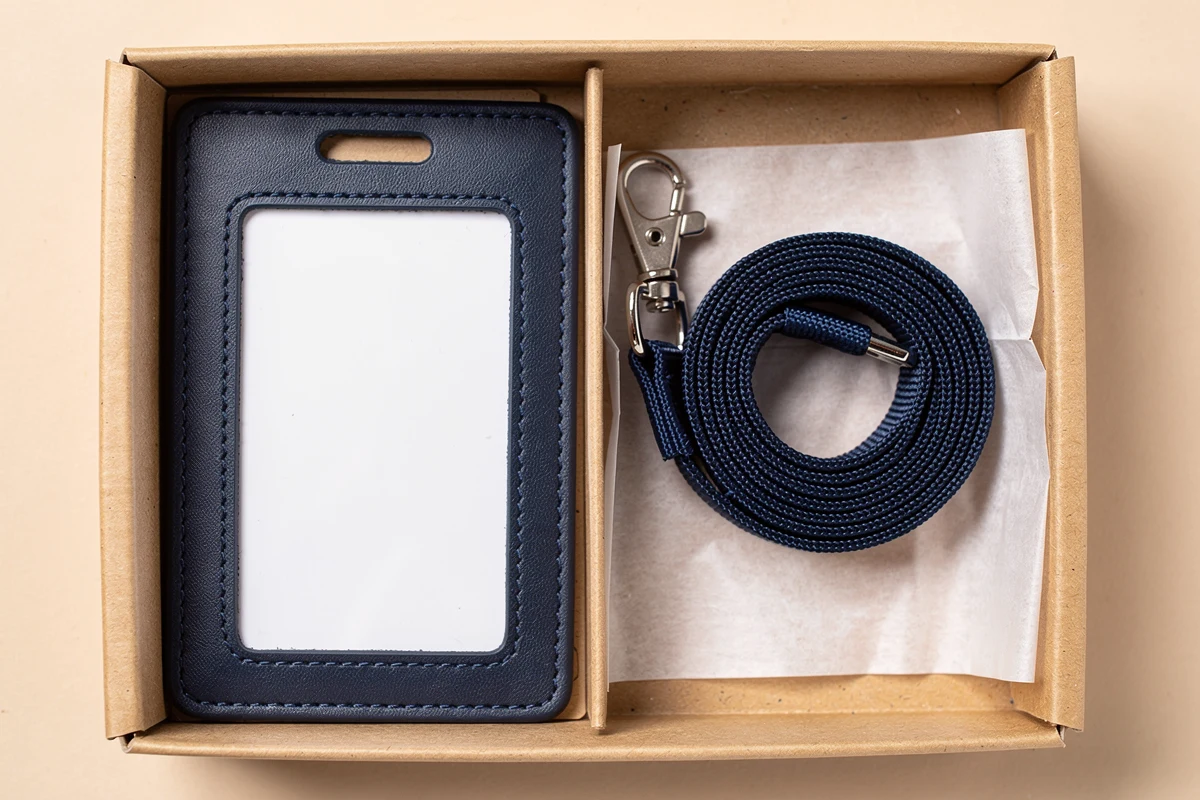
For a holder-and-lanyard set, show the desired accessory position in a packing drawing or photograph. Identify the ring, clasp, reel or other component that could move against the holder. Ask the supplier to propose separation where needed, such as a paper compartment or protective wrap, and verify that it stays effective after handling.
Specify whether the lanyard is attached or supplied separately. These configurations can require different folding and packing arrangements. If it is attached, check that the connector does not place unwanted pressure on the holder while the pack is closed. If it is separate, ensure the recipient can identify the matching accessory.
Avoid sticking labels directly to the finished holder unless the adhesive and removal method have been approved for that surface. Put identification on the unit pack where possible. Similarly, a tissue wrap or insert should be assessed with the actual finish instead of being treated as automatically compatible.
Use the fully assembled set in the packaging review. A box approved around an empty holder does not establish fit for the final holder, lanyard and instruction card combination.
Make colorways and set contents easy to identify
Define what counts as one unit. It could be one holder, one holder with one lanyard, or a larger gift set. List each component in the packing specification so the factory and receiving team use the same count.
Give each variant an unambiguous identifier. A product description, colorway, logo version and accessory combination may all be needed to distinguish similar-looking units. If a barcode is required, ask the buyer’s receiving or retail team to supply its specification and verify a printed example in that workflow.
Agree where identifiers appear: on the individual pack, inner grouping and outer carton. Labels should help the receiving team match the shipment to the purchase order. Do not rely only on a visible product color when the unit is inside an opaque sleeve or box.
For personalized orders, also define how recipient information maps to packed items. A correct name on a holder is not enough if the unit is placed in the wrong labeled pack. Request a checking procedure appropriate to the project without presenting it as an existing factory guarantee.
Compare the full packing cost
Ask quotations to separate the holder, accessories, unit packaging, packaging decoration and any packing labor that is charged separately. For multiple destinations, confirm whether sorting and branch-specific carton preparation are included.
Compare alternatives using the proposed packed quantities, outer dimensions and gross weights. A lower unit-box price does not by itself establish the lower delivered cost. Obtain shipping estimates for the actual options before selecting a format on price alone.
Avoid assuming that a more expensive box provides better protection. Its structure, internal fit and use in the outer carton matter. Likewise, a minimal pack is not automatically unsuitable: it may meet a simple internal-distribution brief once the required protection is confirmed.
When the budget is tight, identify the essential requirements first. These may be surface protection, correct variant identification and a complete accessory set. Decorative additions can then be evaluated against a clear purpose rather than added by default.
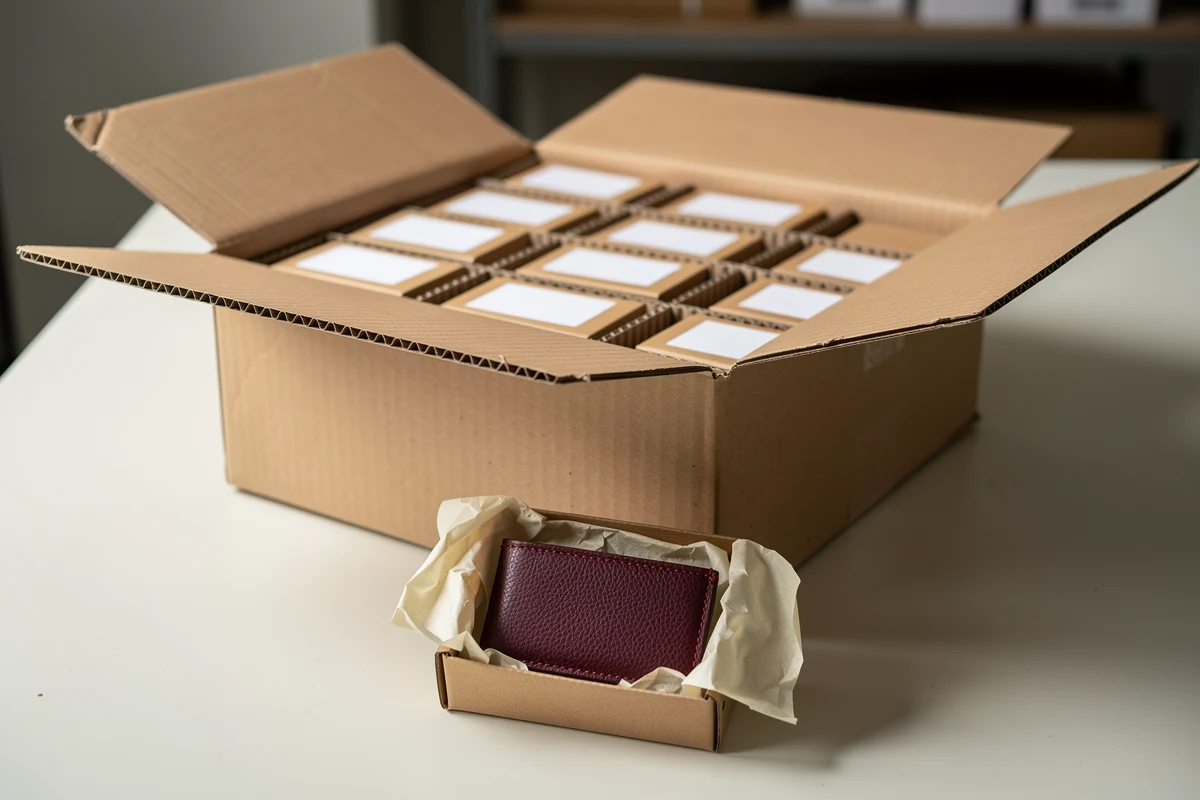
Approve a packed sample before releasing the specification
Review one complete packed unit and the proposed inner and outer arrangement. Open it as the recipient would. Confirm that the product can be removed without damage and that the contents match the listed set. Check whether anything moves into an unintended position during ordinary handling.
Record the approved packaging revision, unit contents, material references and artwork. Include a photograph of the arrangement, but retain measurements and written requirements wherever a photograph would be ambiguous.
A practical packaging brief should cover:
- The delivery channel and intended recipient experience.
- Exact contents of one packed unit, including accessories and inserts.
- Unit-pack structure, internal dimensions and protective separation.
- Approved packaging artwork and variant identifiers.
- Quantities per inner grouping and outer carton.
- Required carton marks, destination sorting and receiving instructions.
- Any agreed transport assessment and approval responsibilities.
Keep packaging approval connected to the product specification. If the holder thickness or accessory changes later, recheck the fit rather than assuming that the approved box remains suitable. Our leather card holder sample checklist covers the wider sample review, while the leather card holder overview introduces the product options.
FAQ
Does every leather card holder order need a gift box?
No. Choose packaging around the delivery channel, protection requirements and recipient experience. An internal distribution order may need a different unit pack from a retail or corporate gift project.
Should the lanyard be packed attached to the holder?
Either arrangement may be suitable. Specify the intended configuration and review the complete packed set, including whether the connector presses against or moves across the holder’s finished surface.
Is a presentation box enough for shipping?
Not necessarily. Evaluate the presentation box within its outer shipping arrangement, including movement and cushioning. Any transport testing requirements should be agreed for the actual packed configuration.
What should appear on variant labels?
Use the identifiers needed to distinguish the product, colorway, logo version and accessory set. Agree the label format with the receiving team and confirm how individual packs, inner groups and cartons will be matched to the order.
What should I send for a packaging quotation?
Provide the unit contents, product and accessory dimensions, preferred pack style, artwork, quantities by variant, delivery channel and destination requirements. Ask the supplier to identify packaging, decoration and packing charges separately where applicable.
To develop a packaging brief for a custom order, contact Xinchao with your holder configuration and distribution plan. Request a proposal for the complete packed set rather than the box alone.