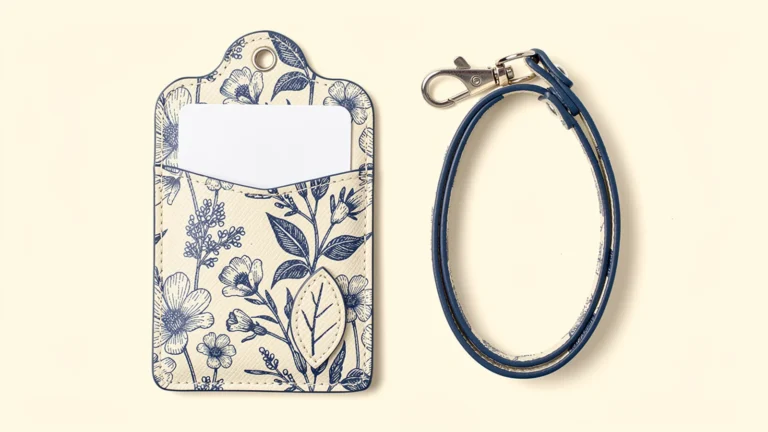

Images are AI-generated design concepts, not production photographs or approved Xinchao specifications. PU denotes synthetic leather, not genuine leather. A closed-looking flap does not prove that every opening is enclosed.
A snap-closure pass case should be specified around the pocket it closes, the cards it carries and the way the user removes them. A button on the product is not enough: check whether the flap actually covers the intended opening and closes without forcing the loaded holder. Card retention and easy access need to be approved together on an assembled sample.
For Japanese-market printed merchandise, a flap can also become part of the illustration. A wave-shaped edge or a separate thin printed decoration can add character, but neither should interfere with closing the case. This guide helps buyers choose and review that construction without promising that a card can never fall out.
Separate card retention from holder attachment
There are two different problems to solve: a card leaving its pocket, and the whole holder becoming detached from a bag or strap. A closure across the pocket opening addresses the first design task. The attachment tab, ring, hook and strap need their own review for the second. A strong-looking strap does not establish that the card stays inside.
Also locate the button before describing the product. A snap on a detachable strap is not necessarily a pocket closure. On a folded holder, a button may keep the body shut while an external pocket remains open. Mark every opening on the drawing and identify which closure, if any, serves it.
Japanese brand REVEL describes separate buttoned internal storage and a flap on an external pocket in its OMAMORI pass case. This illustrates why closures should be considered pocket by pocket. It is not evidence that another design, material or factory has the same retention performance.
Choose a closure layout for the access task
Start by asking how often the card must leave the case. A card shown through a window has a different access task from a card removed repeatedly by hand. If contactless use is intended, confirm it separately with the actual card, reader and complete holder; a snap closure neither guarantees readable performance nor establishes RFID shielding.
| Proposed layout | Reason to consider it | What to check |
|---|---|---|
| Open pocket | Direct access without opening hardware | Fit and retention under the agreed use conditions |
| Narrow snap tab across the opening | A closure with less coverage of the printed face | Whether the card can move around the tab and whether it is easy to grasp |
| Broad flap with a snap | More coverage of the opening and a distinct artwork panel | Remaining side gaps, access and closure with the intended load |
| Folded body with a closure | Keeping several internal panels together | Which pockets are enclosed and which remain exposed |
These are design options, not a universal ranking of security. A broad flap can still leave a route around an edge; an attractive tab can be placed where it does not restrain the intended insert. Ask the supplier to demonstrate the proposed arrangement with representative cards before approving the illustration.

Check both minimum and maximum intended loading
State the actual card dimensions and thickness, including any sleeve that will be used. Record the minimum load as well as the maximum intended load. A case approved only with all slots filled may behave differently when a user removes a card. Conversely, a flap that closes on an empty sample may not reach comfortably when the planned inserts are added.
One or two independent pockets can be a useful starting point for a simple pass case. Three to five can be considered for other carrying needs, but each pocket needs an access and closure review. Do not confuse pocket count with permitted card capacity; the pocket-layout guide explains that distinction.
Look at the closed case from the sides as well as the front. Ask whether an insert can move toward an uncovered opening, whether a card edge catches during removal, and whether the flap can close without bending or squeezing the card. Use non-valuable test cards for prototype checks. Do not treat forcing an oversized load into the sample as a valid fit approval.
Specify the snap as part of the assembled holder
Identify the fastener type rather than using “button” as a complete specification. A mechanical press-stud and a magnetic closure are not interchangeable descriptions. Confirm the selected component, finish, location and assembly with the supplier instead of inferring them from a rendering.
Ask how the inside of the hardware is covered or separated from the card path. Inspect the actual sample for unwanted contact, protruding parts and access obstructions. Agree on any reinforcement around the attachment and closure area; a metal cap visible on the front does not show how it is secured behind the material.
Opening should be manageable for the intended user without pulling on an ornamental projection. Do not specify an arbitrary universal opening force, attachment strength or number of cycles. If those are acceptance requirements, agree on a relevant method and criterion for the finished assembly. Record whether the check concerns the fastener itself, its attachment to the material or the complete holder.

Design the print in open and closed views
Prepare artwork views with the flap both open and closed. Decide whether the flap carries a self-contained motif or covers part of a larger illustration. Keep required wording and important image details clear of the snap cap, seams and the area hidden by the flap. The template should show the actual construction, not just the outer silhouette.
A scalloped outline or thin layered shell motif can complement a full-color ocean design. Keep decorative pieces away from the hinge and finger access area unless their interaction has been deliberately reviewed. A decorative overlay is not automatically a functional retaining strap, and a printed shadow is not a physical layer.
PU denotes synthetic leather, not genuine leather. The layered concepts in this article are thin sheet constructions, not molded figures or 3D-printed parts. See the printed, die-cut and layered pass case guide for related visual options. AI concepts help communicate the idea but cannot establish closure geometry, print durability or hardware strength.
Agree on a practical sample review
Create a short approval sheet identifying the drawing revision, material, fastener and test inserts. Include the following checks as proposed review items, then agree with the supplier how each will be assessed:
- Confirm that each required opening has the intended closure and that the snap engages fully.
- Review minimum and maximum intended loads without forcing the flap or bending cards.
- Try the planned insertion and removal sequence, checking finger access and unwanted hardware contact.
- Examine card movement with the closure secured under agreed handling conditions.
- Inspect the artwork open and closed, including the reverse of decorative pieces.
- Review the holder attachment separately from the pocket closure.
If repeated opening, pull resistance, print abrasion or another performance check is required, define its method, conditions and acceptance criteria before testing. A brief demonstration does not establish a service-life claim. Do not describe the product as theft-proof, waterproof or guaranteed never to drop a card on the basis of a snap alone.
Send an inquiry that names the protected pocket
Include the use scenario, card sizes and sleeves, minimum and maximum loading, independent pocket count, opening directions, closure layout, artwork, material, attachment, packaging and quantity per design. Ask for open, closed and reverse views. Identify any external pocket that remains intentionally open so it is not mistaken for enclosed storage.
The Xinchao leather card holder page is a starting point for discussing materials, print and shape. A proposed snap-flap construction still needs project-specific confirmation of feasibility, sample details and order terms; this guide does not establish a stocked specification.
FAQ
Does a snap guarantee that a card cannot fall out?
No. Retention depends on the complete pocket, flap, loading and handling conditions. Confirm the intended use on an assembled sample and avoid an unconditional no-loss claim.
Is a button on the strap also a card-pocket closure?
Not necessarily. It may only attach the holder to a bag or strap. Identify which opening the button closes and review card retention separately from holder attachment.
Can one closure serve a multi-pocket pass case?
It can be proposed, but confirm which pockets it actually encloses. External or separately oriented openings may remain open, so check each pocket with the intended inserts.
Should the sample be checked with only the maximum number of cards?
No. Review both the minimum and maximum intended loads. The flap should close without forcing the cards, and retention should not depend on an unapproved loading arrangement.
Can a printed flap include an irregular shape or layered decoration?
That can be explored with the supplier. Keep the closure, hinge and finger access functional, and approve the artwork and separate decorative pieces in both open and closed views.
To discuss a printed snap-closure pass case, send Xinchao the pocket layout, insert details and open-and-closed concept so appearance and everyday handling can be reviewed together.