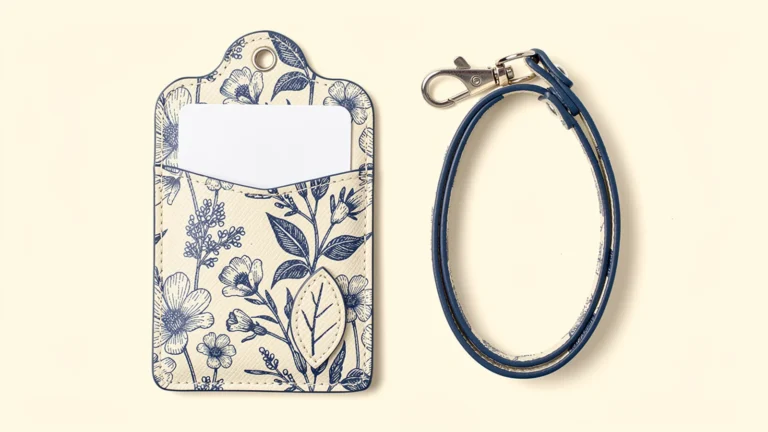
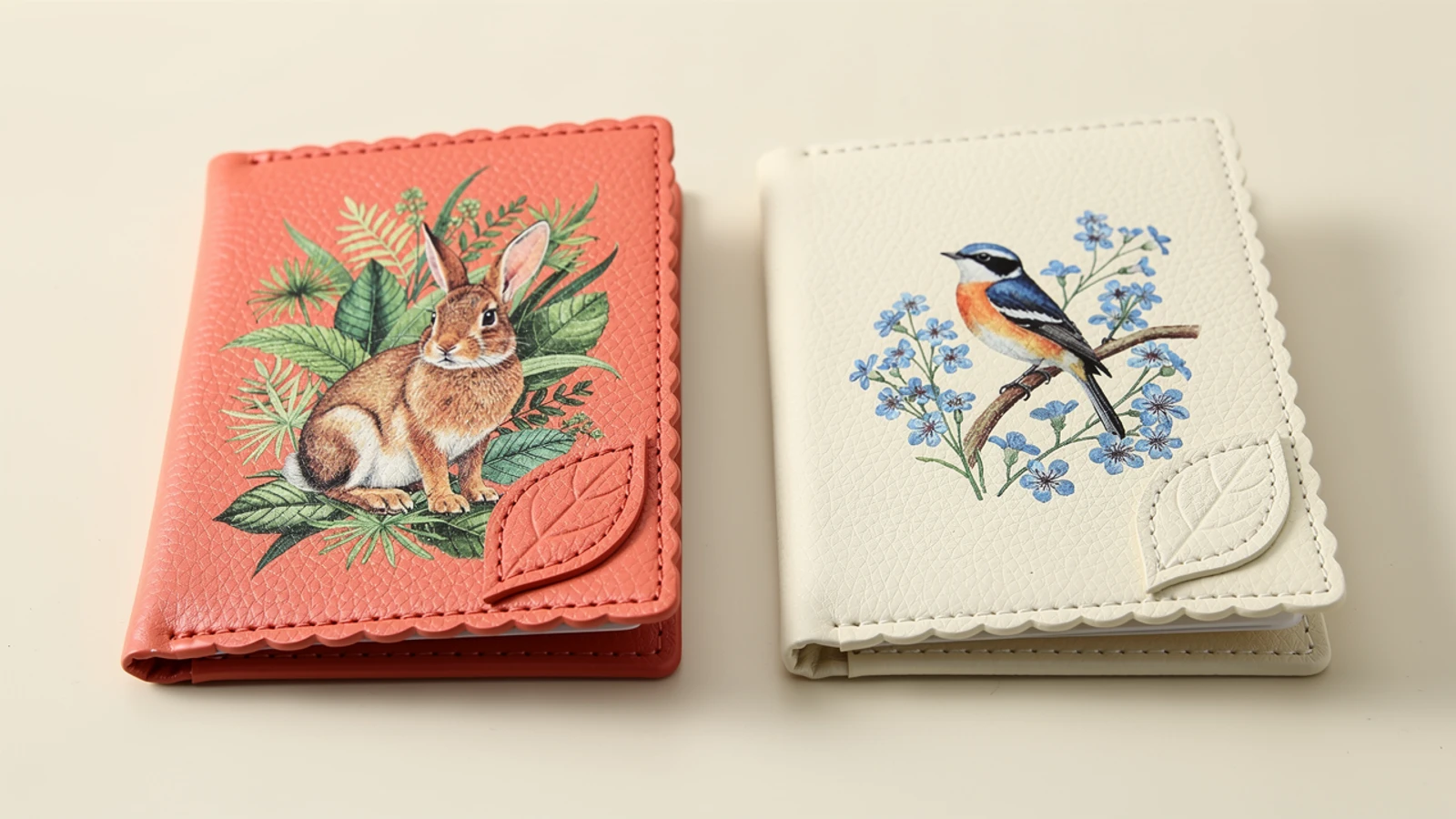
Images are AI-generated design concepts, not production photographs or approved Xinchao specifications. PU denotes synthetic leather, not genuine leather.
A custom bifold pass case gives a printed card holder two distinct states: a compact cover when closed and an accessible card layout when open. To make both work, plan the fold, pocket openings and artwork together. A larger flat print file is not enough; the finished holder must still close naturally with its intended cards inside.
For Japan-focused merchandise, a bifold can be worth considering when the buyer wants an illustrated outer cover and more internal organization than a simple sleeve. It is not automatically the best choice for every project. A one- or two-pocket flat holder may suit frequent card removal better, while a folding layout adds an opening step. The decision should follow the user's routine, not just the desire to add storage.
What a bifold format does—and does not—specify
In Japanese product searches, 二つ折り describes a holder folded into two sections. It does not tell you how many independent pockets it has, whether it has clear windows, or whether either card can be used without removal. Similarly, a two-face layout is not necessarily a two-pocket product.
There are commercial examples of printed multi-pocket bifolds. KEIO's four-pocket bifold pass case is listed as PU synthetic leather with full-color UV inkjet printing. This establishes that the format exists in the Japanese merchandise market; it does not establish the specifications, durability or availability of a proposed Xinchao design.
Treat each requested feature as a separate line in the brief: folding format, number of slots, card capacity, windows, printed surfaces and attachment point. Our one- to five-pocket layout guide explains pocket counting. Here, the main decision is how those features behave around a moving fold.
Start with the closed, open and loaded views
Before finishing artwork, request three views of the concept. The closed view establishes the cover and carry size. The open view locates the pockets and the area that bends. The loaded view shows the intended cards in place, including their exposed edges and the thickness of the complete assembly.
| View | Buyer decision | What to confirm in the sample |
|---|---|---|
| Closed outer cover | Which illustration is the main face? | The face remains recognizable after folding and is not hidden by a strap |
| Open interior | Which card is accessed first? | Fingers can reach each opening without fighting the center fold |
| Loaded and closed | What is the accepted carry condition? | The holder closes as intended without forcing the cards or pocket edges |
| Attached to its strap | How will the user hold and open it? | Hardware does not block the cover or pull across the card openings |
Specify actual card dimensions and thicknesses. An empty sample can appear neat while a fully loaded sample sits open or twists. Conversely, a layout approved with every pocket filled may retain a single card differently. Check the light-load condition as well as the maximum intended load.
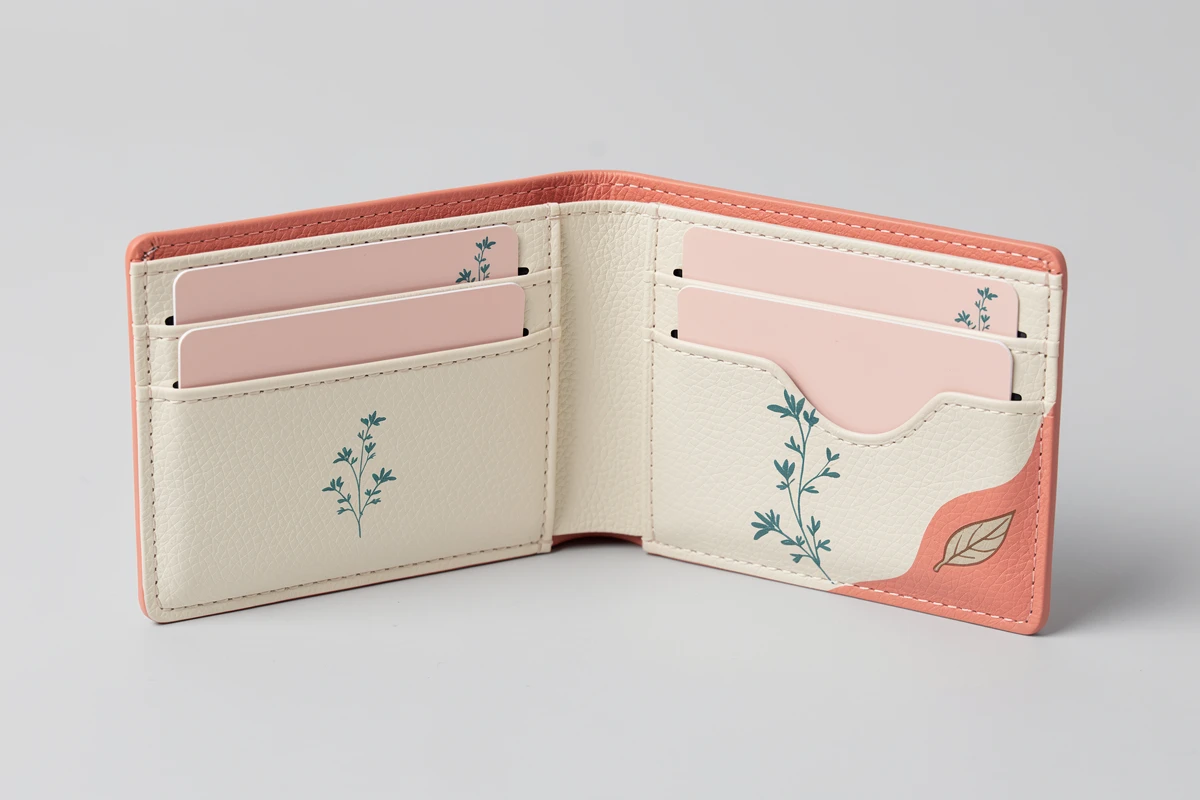
For a simple two-slot concept, one pocket on each internal panel is an easy drawing to discuss. A four-slot version might use two separate pockets per side, but that is only one possible arrangement. Do not add a fifth compartment by assumption: show its opening and confirm that it remains usable after folding.
Give the fold its own artwork zone
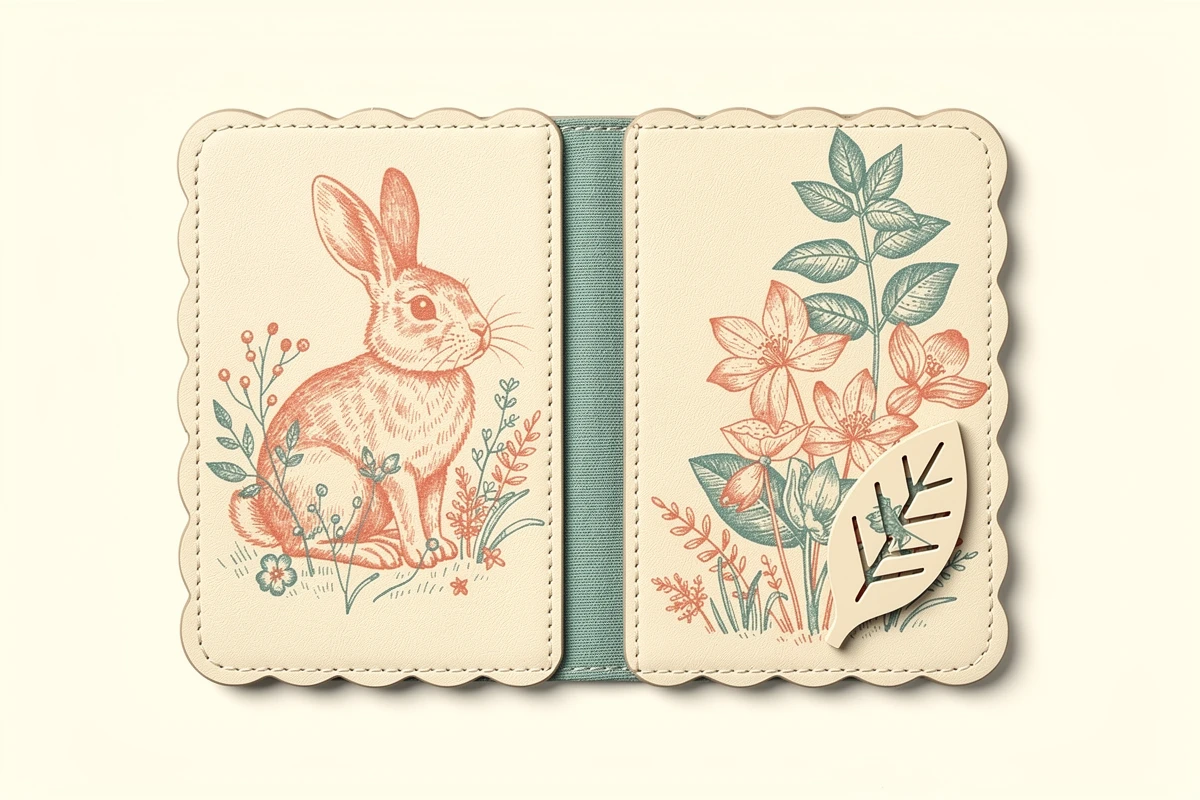
Draw the hinge area on the production template before placing important visual details. A face, small logo or short line of text positioned across the fold may look complete when the cover is flat but divided when the case is closed. For an original character design, keep the identifying features on one cover panel and let less critical background elements connect the composition.
A continuous landscape or botanical pattern can still cross the spine as a design proposal. Ask for both the flat artwork proof and the folded sample so that the approved composition is clear in both states. Do not assume a digital mockup proves registration, color or behavior at the bend.
Keep print coverage separate from print suitability. A supplier may be able to place ink over an area, but the selected material, surface finish, ink system and construction still need to be evaluated as a combination. Rather than promising that every printed hinge will resist cracking, agree on a sample check that opens and closes the assembled holder under a defined method. Record visible changes and the acceptance criteria before production approval.
There is no universal safe distance from a fold that applies to every PU or genuine-leather holder. Use the confirmed template and the supplier's construction guidance. PU is synthetic leather, not genuine leather; a sample in one material should not be used to approve a different material without review.
Keep irregular shapes and raised panels away from the moving joint
An irregular outline can make the closed cover distinctive without changing the rectangular space needed by the cards. A leaf-shaped edge, rounded ears or a gently scalloped outer border can be explored on the free edges of the cover. Keep the central folding region straightforward unless a different construction has been specifically developed and sampled.
Check both halves together. A protruding decorative shape on one panel may collide with the opposite panel when the case closes. It may also catch a pocket lip or interfere with the strap. These relationships are difficult to judge from a front-only rendering, so include an open view and a closed side view in the approval set.
For a layered effect, specify a separate thin printed leather or PU appliqué and how it is attached. Placing it entirely on one cover panel is a practical starting point. A decorative piece that bridges the hinge can constrain movement and needs separate assessment. Printed shadows are a flat visual effect; an attached panel creates a physical step. Neither should be described as 3D printing without an actual 3D-printing process.
Keep decorations and pocket layers separate in the specification. A stitched rabbit silhouette is not an extra card slot unless it genuinely forms an accessible storage compartment. For more visual options, see the guide to printed, die-cut and layered pass cases.
Test the action, not only the appearance
Ask the reviewer to follow the intended sequence: pick up the attached holder, open it, identify the desired card, remove that card if required, replace it and close the cover. Watch for a strap crossing the hinge, card corners touching the opposite pocket, or fingers having to bend the case excessively to reach an opening.
If an interior window displays an ID, confirm the required information is visible when the case is open. A closed cover can conceal that display, but it should not be marketed as a privacy or security guarantee. Likewise, adding a snap, magnet or other closure is a separate construction decision, not an automatic feature of a bifold. Specify it only when needed and assess compatibility with the intended cards and use.
Folding is also not proof of contactless-card separation. JR East's Suica guidance warns against placing multiple contactless IC cards together in a pass case. Do not claim that opening the holder or putting cards on opposite panels automatically prevents interference. Follow the card operator's instructions and define any specialized function separately.
Build a useful bifold sample brief
For an OEM inquiry, send the open and closed artwork together with the card layout. Include the requested material, number of independent slots, card dimensions, windows, printed sides, irregular edges, decorative layers and strap attachment. Add quantities per design, packaging requirements and the required delivery date so the proposal can be reviewed in context.
Ask the supplier to distinguish the outer cover, lining, pocket panels and decorative pieces. “PU bifold with four pockets” is not a complete construction specification. If the hinge is the main uncertainty, request confirmation of that area before refining every illustration detail.
During sample approval, keep a record of:
- The agreed material and artwork revision used for the sample.
- Card types and loading conditions used for fit checks.
- Open and closed photographs, including the spine and side profile.
- Any interference between decoration, pockets, cards and hardware.
- The agreed method for checking repeated opening and closing, and what constitutes an unacceptable change.
- The differences still to be corrected before production approval.
These are proposed purchasing checks, not a claim that a particular test has already been performed by Xinchao. Do not assign a service life, fixed cycle count or universal tolerance without a relevant agreed basis. A changed pocket arrangement or material may require a fresh sample even when the cover illustration stays the same.
For projects where the illustrated cover is central to the product concept, a bifold can separate the main artwork from the storage area. Where immediate card access is the priority, a simpler flat holder may be more appropriate. Use the leather card holder product page to start a discussion of the available direction, then confirm the specific construction through drawings and samples.
FAQ
Does a bifold pass case always have four pockets?
No. Bifold describes the folding format, not the pocket count. Specify each independent pocket and its opening separately, whether the design has two, four or another agreed number of slots.
Can full-color artwork cross the center fold?
It can be proposed, but the result must be checked on the selected material and assembled sample. Keep critical faces, lettering and logos away from the fold where practical, and approve both the flat layout and closed appearance.
Can a bifold pass case use an irregular outer shape?
Yes, an irregular outline can be considered around the functional card area. Confirm that decorative extensions do not collide when folded or obstruct the pockets, strap and card removal.
Can a thin raised printed decoration be added to the cover?
A separate thin printed panel can be considered as an appliqué. Specify its material and attachment independently, and check that it does not bridge or restrict the hinge. It is not an additional pocket unless it creates a usable storage compartment.
Does opening a bifold prevent two IC cards from interfering?
Do not assume so. A folding layout is not evidence of contactless compatibility. Follow the card operator's guidance and do not claim that opposite panels or an open cover automatically prevent interference.
To discuss an original bifold design, send Xinchao the open and closed views of your pass case together with the intended card layout and printed artwork.